-
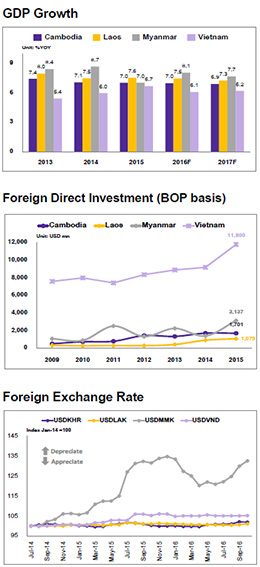
CLMV countries look for ways towards seamless connectivity as CLMV leaders have agreed on cooperative measures to enhance their connectivity at the 8th CLMV Cooperation Summit in Hanoi in October. Leaders pointed to the challenges facing the Mekong Region, including limited human resources, underdeveloped infrastructure, regional and global economic instability, and open economies’ vulnerability. To maintain economic growth momentum and improve competitiveness, leaders agreed to simultaneously reform domestic economy, maintain economic stability, create an optimal business environment, and proactively integrate more into the regional and global economies. According to the Summit, the CLMV nations will accelerate the building of missing links and upgrade roads along the North–South Economic Corridor, the East–West Economic Corridor, and the Southern Economic Corridor. CLMV leaders agreed to step up the harmonization of cross-border procedures and develop industrial zones along the corridors to facilitate trade and investment. They will promote border trade via harmonizing member countries’ border-trade procedures and developing a network of border markets, carry out trade and investment promotion activities, and facilitate the investment of CLMV enterprises in each other’s markets. Regarding industrial cooperation, the four countries will collectively foster collaboration in industrial policy development and small and medium enterprise policy development.
-
Under the US Donald Trump’s presidency and now with the Trans-Pacific Partnership (TPP) no longer being feasible, CLMV nations would likely focus more on realizing the Regional Comprehensive Economic Partnership (RCEP), a China-backed trade deal. Concerning the effect after the US election, many parts of president-elect Trump’s campaign to “Make America Great Again” are mostly inward-looking policies to boost the US economy and paying less attention to CLMV countries. Specifically, the TPP is of concern to Vietnam mainly, if the mega trade deal does not become reality, then the existing option of RCEP will be given more consideration for countries in this region.
Sources: ADB, Bloomberg, CEIC, CIA, IMF, World Bank, Focus Economics, Capital Economics
ดาวน์โหลดบทวิเคราะห์ฉบับเต็มสำหรับรายละเอียดแต่ละประเทศ
|
|
![20161124.jpg]() |