Thai exports in January 2026 recorded the strongest growth in four years, but the outlook faces rising uncertainty from additional US tariff measures.
SCB EIC has revised Thai exports’ projection to return to expansion of 1.6% in 2026 (previously -1.5%).
The value of Thai exports in January 2026 stood at USD 31,573.1 million, expanding by 24.4%YOY — the highest growth rate in four years. This marked an acceleration from 16.8% in the previous month and was significantly higher than expectations (SCB EIC projected 8.5%, while the Reuters Poll median stood at 9.4%). On a seasonally adjusted basis, exports expanded by as much as 10.6%MOM_SA, continuing from 7.3%MOM_SA in the preceding month. Export performance this month was supported by two key drivers: (1) the global upcycle in electronics products, driven by AI-related investment trends and rising demand for associated products. Exports of electronic products surged by 67%, accelerating from 52.8% in the previous month and marking 22 consecutive months of expansion; and (2) unwrought gold exports expanded strongly by 136.2%, partly reflecting record-high gold prices during the month, supported by continued gold purchases by central banks and heightened demand for safe-haven assets amid elevated geopolitical risks.
Overall, exports of electronic products and gold contributed as much as (CTG) 11.4% and 6.3%, respectively, to the total export growth of 24.4% in January.
Figure 1: Thai Export Value by Product Category and Key Markets.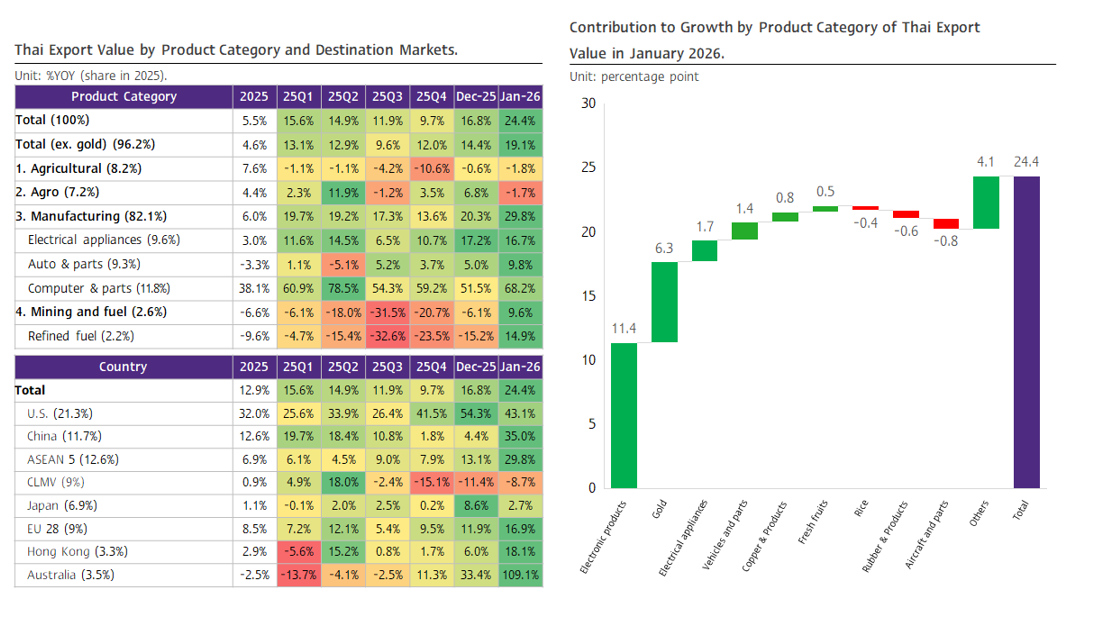
Source: SCB EIC analysis based on data from the Ministry of Commerce.
Merchandise import value also recorded the highest expansion in four years, resulting in a substantial trade deficit for Thailand. The value of merchandise imports in January 2026 stood at USD 34,876.49 million, expanding by 29.4%YOY, compared with 18.8% in the previous month, and significantly exceeding expectations (SCB EIC projected 10.5%, while the Reuters Poll median was 10.3%).
The main imported categories were: (1) raw materials and intermediate goods, which expanded sharply by 50.3% (CTG = 20.5% out of total growth of 29.4%), particularly electrical and electronic equipment and components, as well as gold; and (2) capital goods, which grew by 29.5% (CTG = 7.7% out of 29.4%), especially electrical machinery and parts, and mechanical machinery and parts.
The customs basis trade balance in January 2026 recorded a deficit of USD -3,303.4 million, larger than market expectations (SCB EIC had projected USD -2,100 million, while the Reuters Poll median expected USD -2,030 million), marking the fourth consecutive month of trade deficit.
|
Special Topic: The Direction of US Tariff Barriers Following the US Supreme Court Ruling
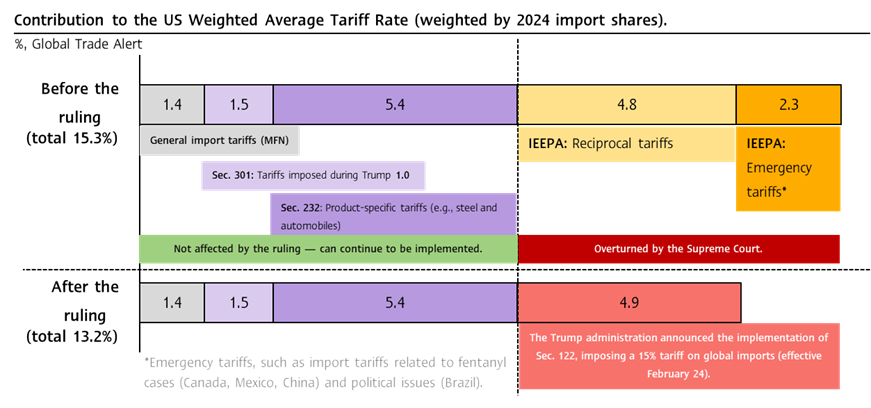
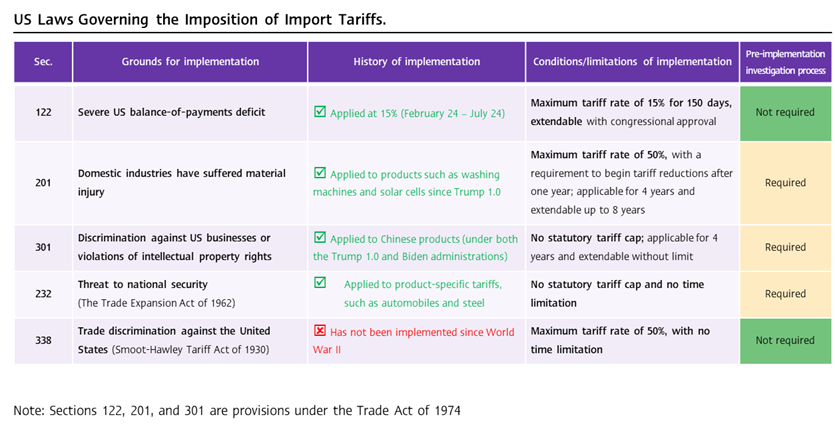
The Trump administration responded immediately by imposing a 15% across-the-board tariff on global imports under the authority of Sec. 122, effective for a period of 150 days.
Figure 2: The US Weighted Average Tariff Rate Will Decline Only Slightly After February 24.
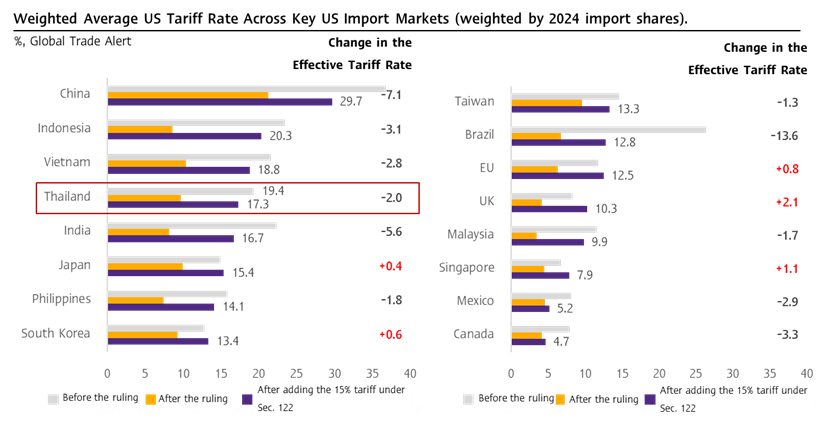
Under the Worldwide tariff implemented by the US to replace the IEEPA authority, the average tariff rate imposed on Thai exports will decline only slightly.
Figure 3: Countries Previously Subject to Reciprocal Tariffs Above 15% Will Temporarily Benefit.
Figure 4: The US Government Still Has Other Legal Instruments to Impose Import Tariffs.
The impact of the decline in US import tariff rates on the global economy remains unclear, given the persistently high level of uncertainty.
SCB EIC assesses that, in the short term, Thai exports may receive some positive impact. However, they will face mounting pressure from the uncertainty surrounding additional US tariff measures that may be introduced in the period ahead. |
1 In its ruling on Learning Resources, Inc. v. Trump (a learning materials importer) together with Trump v. V.O.S. Selections, Inc. (a group of wine import businesses), the Supreme Court’s majority opinion held that the executive branch’s authority under the IEEPA in cases of economic emergency does not extend to the imposition of import tariffs. The authority to levy import tariffs, the Court emphasized, resides with the legislative branch.
2 Under the assumption that products already subject to product-specific tariffs will be exempted.
SCB EIC has revised Thai exports’ projection to return to expansion of 1.6% in 2026 (previously -1.5%). The upward revision reflects continued support from the electronics upcycle, driven by strengthening global demand, which has bolstered exports across several Asian economies, including Thailand as a key producer in this sector. This is illustrated in Figure 5 (bottom right), where export values of developing Asian economies continue to expand robustly, particularly in electronic products such as Taiwan, South Korea, Vietnam, and Thailand.
In addition, the outlook for the global economy and trade has improved. SCB EIC has revised up its global GDP growth forecast for 2026 to 2.7% (from 2.5%). Meanwhile, the International Monetary Fund (IMF) and the World Trade Organization (WTO) have also upgraded their projections for global trade volume in 2026, reflecting a more favorable global economic outlook. Rapid advancements in AI development are also expected to serve as a key driver of global trade this year and help mitigate the impact of US tariffs.
Figure 5: The Outlook for the Global Economy and Trade Has Improved.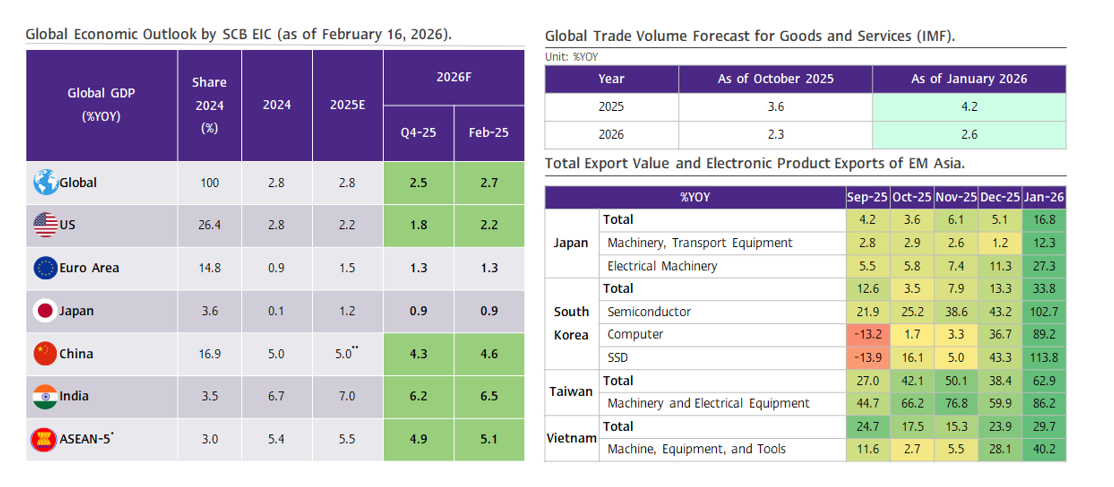
Source: SCB EIC analysis based on data from the IMF and CEIC.