FLASH
09 October 2026
Thailand’s Trade Deficit Narrowed Significantly in August, but Several Risk Factors Need to Be Monitored Toward the End of This Year
Export value in August stood at USD 34,618.72 million, expanding strongly by 24.3%, close to expectations
Overall, Thai exports in August 2026 continued to expand.
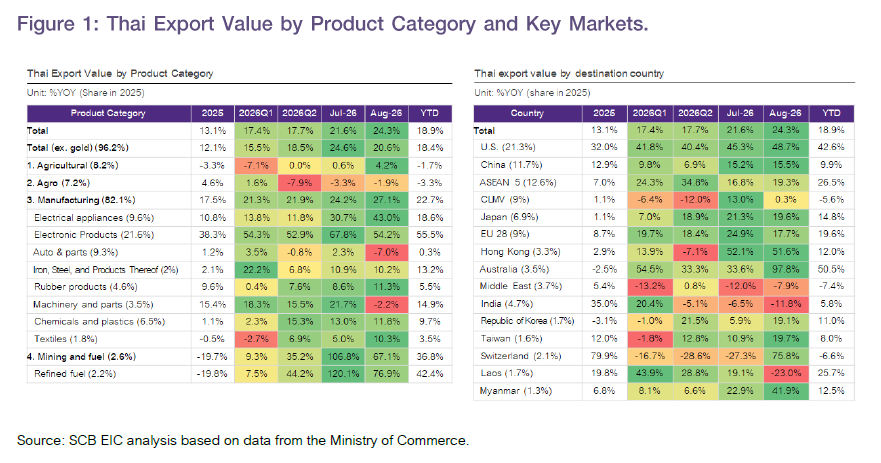
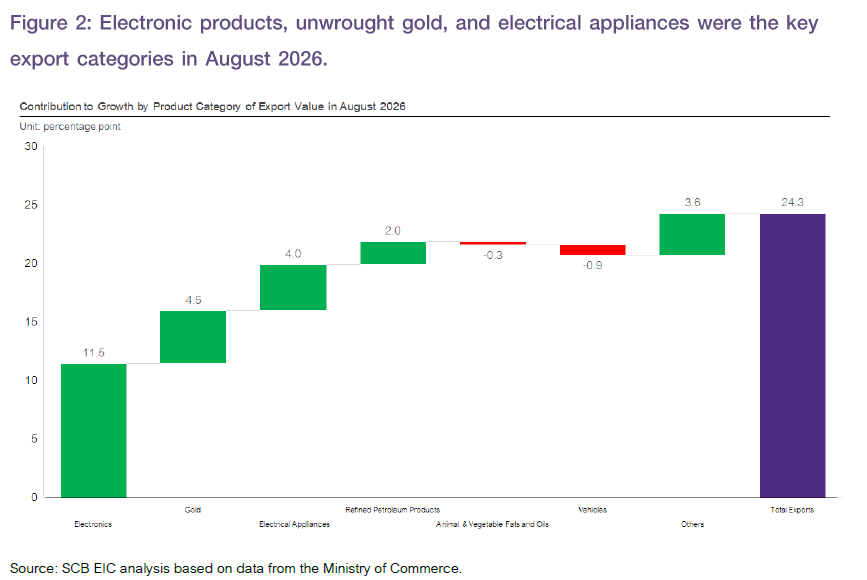
Export value in August stood at USD 34,618.72 million, expanding strongly by 24.3%, close to expectations (SCB EIC estimated 25.9%, while the Reuters Poll median was 24.9%). Although the 24.3% growth marked the highest %YOY expansion in 56 months, seasonally adjusted export value contracted slightly by -0.2%MOM_SA. This reflects that the strong growth this month was partly driven by a low base in August last year, when Thai exports began to be affected by the first wave of US tariff barriers. Overall, Thai export value during the first 8 months of 2026 expanded strongly by 18.9% (Figures 1 and 2).
Exports in August continued to be supported by electronic products and the US market.
1. Exports of electronic products continued to expand strongly by 54.2%, although slowing from 67.8% in July. This product group continued to benefit from the electronics upcycle, as well as the global expansion trend in investment in the electronics industry and Data center infrastructure. This was reflected in exports of this product group to all 15 of Thailand’s key trading partners expanding, together accounting for 94% of Thailand’s total electronic product export value this month. In particular, exports to Ireland, South Korea, Singapore, Vietnam, and the US expanded strongly by 173.8%, 166.2%, 98.8%, 73.2%, and 64.6%, respectively. Electronic products contributed 11.5 percentage points to Thai export growth this month, accounting for nearly half of the total export growth of 24.3%.
2. Exports to the US expanded strongly by 48.7%, continuing from 45.3% in July. In particular, exports of electronic products, which are not yet subject to additional US import tariffs, surged by 64.6%. Other product categories also expanded strongly by 35.6%, reflecting continued demand for Thai products in the US market. Part of this growth may have reflected accelerated shipments of Thai products to the US amid uncertainty over additional import tariffs under Section 301. Exports to the US contributed 9.9 percentage points to Thai export growth in August.
3. Exports of unwrought gold returned to strong growth of 112.5% after contracting for 2 consecutive months by -67.5% and -59.2% in June and July, respectively. The rebound was supported by exports to Australia and Switzerland, which surged by 8,994.5% and 78.4%, respectively, together accounting for around 87.8% of Thailand’s total unwrought gold export value this month. Part of the increase may have reflected higher gold prices in August. Unwrought gold exports contributed 4.5 percentage points to Thai export growth this month.
Import growth slowed this month but remained very strong.
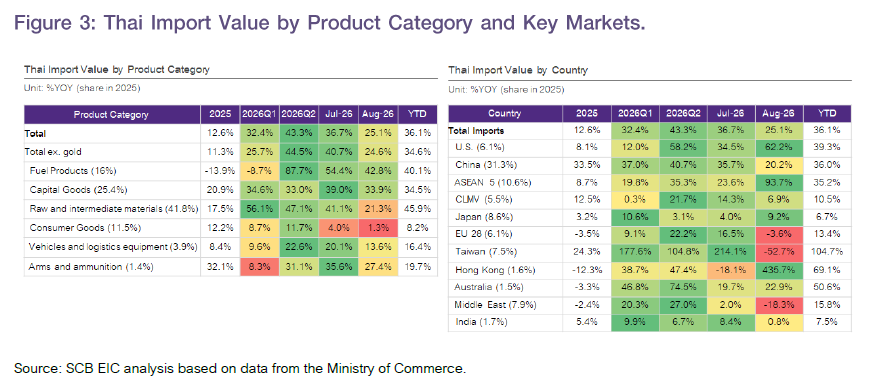
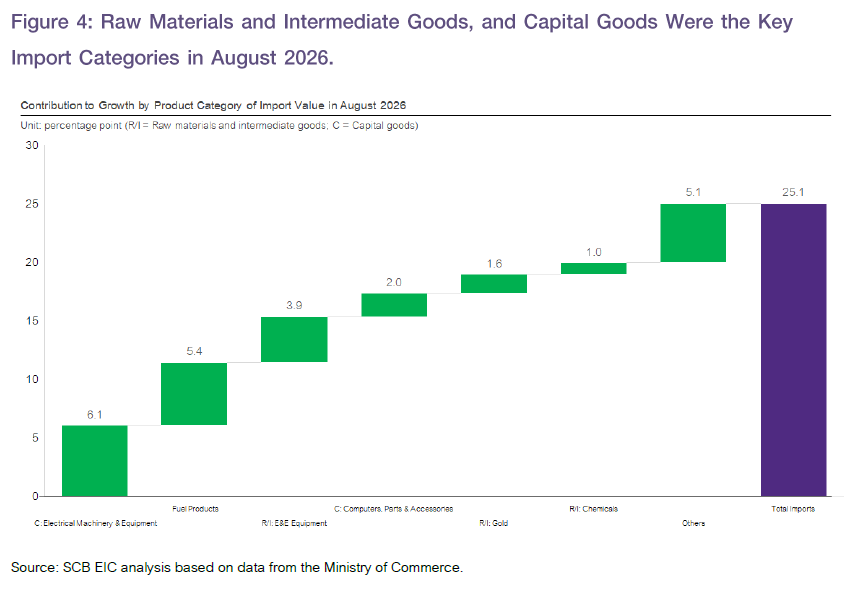
Import value in August stood at USD 37,101.4 million, expanding by 25.1%, slowing from 36.7% in the previous month and below expectations (SCB EIC estimated 33.6%, while the Reuters Poll median was 31.4%). Overall, Thai import value during the first 8 months of 2026 expanded strongly by 36.1% (Figures 3 and 4).
Imports slowed across several key categories but remained very high.
(1) Capital goods imports expanded strongly by 33%, slowing slightly from 39% in the previous month. Imports in this category contributed 9.2 percentage points to import growth this month, out of total import growth of 25.1%. Imports from China accounted for 46.2% of Thailand’s total capital goods import value this month. Key products included computers, equipment and parts, and electrical machinery and parts, which expanded strongly by 71.1% and 59.7%, respectively (CTG: 2% and 6.1%). The strong growth in capital goods imports was consistent with the robust expansion in private investment in recent periods, particularly investment related to electronics and digital industries, such as Data center infrastructure, while Thailand has limited domestic production capacity for these types of capital goods.
(2) Fuel imports continued to expand strongly by 42.4%, despite slowing from 54.4% in the previous month. Imports in this category contributed 5.4 percentage points to Thai import growth in August, out of total import growth of 25.1%. This was driven by crude oil imports, which expanded strongly by 54.4% (CTG: 4.7%), particularly imports from the US, which surged by 213.3%, accelerating sharply from 10.9% in the previous month. In contrast, imports from the UAE and Saudi Arabia contracted sharply by -35.7% and -31.3%, respectively, reflecting Thailand’s diversification of oil import sources away from the Middle East. This was consistent with developments in several regional economies, such as Japan, which also increased oil imports from the US substantially to reduce reliance on the Middle East.
(3) Raw materials and intermediate goods expanded by 21.3%, slowing sharply from 41.1%. This was driven by imports from Taiwan, which contracted significantly by -70.4%, compared with strong growth of 259.6% and 241.1% in June and July, respectively. Part of the contraction may have reflected a high base effect, as imports from Taiwan had expanded strongly by 189.6% in August 2025. Nevertheless, imports in this category continued to expand at a solid and high rate, contributing 9.4 percentage points to Thai import growth in August 2026, out of total import growth of 25.1%. Key products included electrical appliance and electronic equipment components, which expanded by 25.4% (CTG: 3.9%), consistent with the continued strong growth in electronic product exports. Meanwhile, gold imports returned to growth of 35.7% (CTG: 1.6%) after contracting by -32.7% in the previous month.
The customs-basis trade balance recorded a continued deficit of USD -2,482.7 million in August 2026, the smallest deficit so far this year and better than expected (SCB EIC and the Reuters Poll median estimated USD -3,900 million). Overall, Thailand’s cumulative trade deficit during the first 8 months of this year stood at USD -37,837.2 million.
Exports and imports are likely to continue expanding, but exports face downside risks from US import tariffs, while imports face upside risks from the war.
SCB EIC assesses that Thai exports are likely to continue expanding strongly in the period ahead, despite some moderation, supported by the global upcycle in electronics, digital industries, and Data center investment. In addition, global demand has remained resilient despite heightened uncertainty on multiple fronts. Meanwhile, the impact of US import tariff measures under Section 301 related to forced labor remains relatively limited, as several of Thailand’s key export products continue to be exempt from additional tariffs. Nevertheless, Thai exports still face downside risks from potential additional US import tariffs under Section 301 related to Structural Excess Capacity, which are expected to be announced in late September or October, as well as from other issues that the US may investigate further going forward.
Meanwhile, the extension of the US-China trade truce by another 2 months, until January 10, 2027, from the previous expiration date of November 10, 2026, following President Xi Jinping’s official visit to the US on September 24, 2026, has helped ease concerns over the global trade outlook in the short term. However, the 2-month extension remains relatively short, leaving risks in early 2027 if the two sides are unable to further extend the truce or reach an additional agreement.
Thai imports are also likely to continue expanding strongly, in line with exports, driven by higher imports of raw materials and intermediate goods, as well as capital goods. This is consistent with the strong expansion in electronic product exports and AI-related investment, particularly Data center investment in Thailand. However, Thai import value faces upside risks from higher energy prices, which could further widen the trade deficit if the Middle East conflict intensifies again.
![F1.png]()
![F2.png]()
![F3.png]()
![F4.png]()
Export value in August stood at USD 34,618.72 million, expanding strongly by 24.3%, close to expectations (SCB EIC estimated 25.9%, while the Reuters Poll median was 24.9%). Although the 24.3% growth marked the highest %YOY expansion in 56 months, seasonally adjusted export value contracted slightly by -0.2%MOM_SA. This reflects that the strong growth this month was partly driven by a low base in August last year, when Thai exports began to be affected by the first wave of US tariff barriers. Overall, Thai export value during the first 8 months of 2026 expanded strongly by 18.9% (Figures 1 and 2).
Exports in August continued to be supported by electronic products and the US market.
1. Exports of electronic products continued to expand strongly by 54.2%, although slowing from 67.8% in July. This product group continued to benefit from the electronics upcycle, as well as the global expansion trend in investment in the electronics industry and Data center infrastructure. This was reflected in exports of this product group to all 15 of Thailand’s key trading partners expanding, together accounting for 94% of Thailand’s total electronic product export value this month. In particular, exports to Ireland, South Korea, Singapore, Vietnam, and the US expanded strongly by 173.8%, 166.2%, 98.8%, 73.2%, and 64.6%, respectively. Electronic products contributed 11.5 percentage points to Thai export growth this month, accounting for nearly half of the total export growth of 24.3%.
2. Exports to the US expanded strongly by 48.7%, continuing from 45.3% in July. In particular, exports of electronic products, which are not yet subject to additional US import tariffs, surged by 64.6%. Other product categories also expanded strongly by 35.6%, reflecting continued demand for Thai products in the US market. Part of this growth may have reflected accelerated shipments of Thai products to the US amid uncertainty over additional import tariffs under Section 301. Exports to the US contributed 9.9 percentage points to Thai export growth in August.
3. Exports of unwrought gold returned to strong growth of 112.5% after contracting for 2 consecutive months by -67.5% and -59.2% in June and July, respectively. The rebound was supported by exports to Australia and Switzerland, which surged by 8,994.5% and 78.4%, respectively, together accounting for around 87.8% of Thailand’s total unwrought gold export value this month. Part of the increase may have reflected higher gold prices in August. Unwrought gold exports contributed 4.5 percentage points to Thai export growth this month.
Import growth slowed this month but remained very strong.
Import value in August stood at USD 37,101.4 million, expanding by 25.1%, slowing from 36.7% in the previous month and below expectations (SCB EIC estimated 33.6%, while the Reuters Poll median was 31.4%). Overall, Thai import value during the first 8 months of 2026 expanded strongly by 36.1% (Figures 3 and 4).
Imports slowed across several key categories but remained very high.
(1) Capital goods imports expanded strongly by 33%, slowing slightly from 39% in the previous month. Imports in this category contributed 9.2 percentage points to import growth this month, out of total import growth of 25.1%. Imports from China accounted for 46.2% of Thailand’s total capital goods import value this month. Key products included computers, equipment and parts, and electrical machinery and parts, which expanded strongly by 71.1% and 59.7%, respectively (CTG: 2% and 6.1%). The strong growth in capital goods imports was consistent with the robust expansion in private investment in recent periods, particularly investment related to electronics and digital industries, such as Data center infrastructure, while Thailand has limited domestic production capacity for these types of capital goods.
(2) Fuel imports continued to expand strongly by 42.4%, despite slowing from 54.4% in the previous month. Imports in this category contributed 5.4 percentage points to Thai import growth in August, out of total import growth of 25.1%. This was driven by crude oil imports, which expanded strongly by 54.4% (CTG: 4.7%), particularly imports from the US, which surged by 213.3%, accelerating sharply from 10.9% in the previous month. In contrast, imports from the UAE and Saudi Arabia contracted sharply by -35.7% and -31.3%, respectively, reflecting Thailand’s diversification of oil import sources away from the Middle East. This was consistent with developments in several regional economies, such as Japan, which also increased oil imports from the US substantially to reduce reliance on the Middle East.
(3) Raw materials and intermediate goods expanded by 21.3%, slowing sharply from 41.1%. This was driven by imports from Taiwan, which contracted significantly by -70.4%, compared with strong growth of 259.6% and 241.1% in June and July, respectively. Part of the contraction may have reflected a high base effect, as imports from Taiwan had expanded strongly by 189.6% in August 2025. Nevertheless, imports in this category continued to expand at a solid and high rate, contributing 9.4 percentage points to Thai import growth in August 2026, out of total import growth of 25.1%. Key products included electrical appliance and electronic equipment components, which expanded by 25.4% (CTG: 3.9%), consistent with the continued strong growth in electronic product exports. Meanwhile, gold imports returned to growth of 35.7% (CTG: 1.6%) after contracting by -32.7% in the previous month.
The customs-basis trade balance recorded a continued deficit of USD -2,482.7 million in August 2026, the smallest deficit so far this year and better than expected (SCB EIC and the Reuters Poll median estimated USD -3,900 million). Overall, Thailand’s cumulative trade deficit during the first 8 months of this year stood at USD -37,837.2 million.
Exports and imports are likely to continue expanding, but exports face downside risks from US import tariffs, while imports face upside risks from the war.
SCB EIC assesses that Thai exports are likely to continue expanding strongly in the period ahead, despite some moderation, supported by the global upcycle in electronics, digital industries, and Data center investment. In addition, global demand has remained resilient despite heightened uncertainty on multiple fronts. Meanwhile, the impact of US import tariff measures under Section 301 related to forced labor remains relatively limited, as several of Thailand’s key export products continue to be exempt from additional tariffs. Nevertheless, Thai exports still face downside risks from potential additional US import tariffs under Section 301 related to Structural Excess Capacity, which are expected to be announced in late September or October, as well as from other issues that the US may investigate further going forward.
Meanwhile, the extension of the US-China trade truce by another 2 months, until January 10, 2027, from the previous expiration date of November 10, 2026, following President Xi Jinping’s official visit to the US on September 24, 2026, has helped ease concerns over the global trade outlook in the short term. However, the 2-month extension remains relatively short, leaving risks in early 2027 if the two sides are unable to further extend the truce or reach an additional agreement.
Thai imports are also likely to continue expanding strongly, in line with exports, driven by higher imports of raw materials and intermediate goods, as well as capital goods. This is consistent with the strong expansion in electronic product exports and AI-related investment, particularly Data center investment in Thailand. However, Thai import value faces upside risks from higher energy prices, which could further widen the trade deficit if the Middle East conflict intensifies again.