Exports surged in June, but a spike in imports widened the trade deficit, while the US imposed a 12.5% Section 301 tariff on Thailand as expected.
SCB EIC expects Thai exports to remain strong, supported by the global electronics upcycle, though growth will slow in H2/2026.
Key summary
|
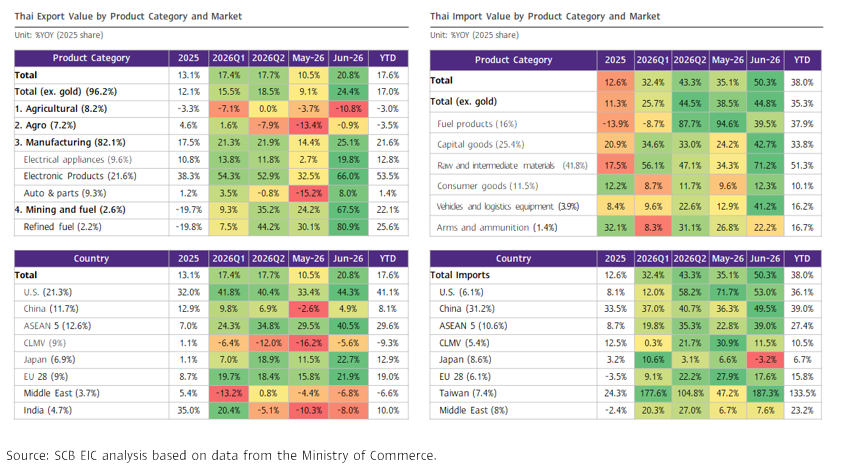
Exports in June expanded strongly above market expectations but are likely to slow going forward. Thai export value in June 2026 stood at USD 34,655.92 million, expanding by 20.8%YOY and accelerating from 10.6% in the previous month. The figure was close to SCB EIC’s estimate but well above the market consensus (SCB EIC estimated 20.5%, while the Reuters Poll median was 16.9%). Export growth this month continued to be supported by two key factors. (1) The global electronics upcycle, driven by AI investment trends and demand for related products. Electronic product exports expanded strongly by 66%, marking the 27th consecutive month of growth. (2) Exports to the US grew strongly by 44.3%. In particular, electronic product exports to the US surged by 72.9%, while other product categories excluding electronics expanded by 19.1%, reflecting demand for Thai products as well as front-loading imports ahead of a new round of import tariffs. Electronic product exports and exports to the US contributed (CTG) 14.7% and 9.7%, respectively, to Thai export growth this month, out of total export growth of 20.8%.
SCB EIC views that Thai exports are likely to continue expanding well, supported by the global electronics upcycle. However, overall export growth in H2/2026 is expected to gradually slow as the boost from front-loading shipments ahead of tariff barriers fades and the base effect becomes less favorable due to the higher base in H2 last year. Looking ahead, risks to exports to the US under Section 301 will be associated with tighter scrutiny of country of origin and supply chain credibility (Figures 1 and 6).
Figure 1: Electronic Products and the US and ASEAN-5 Markets Supported Thai Export Growth in H1/2026.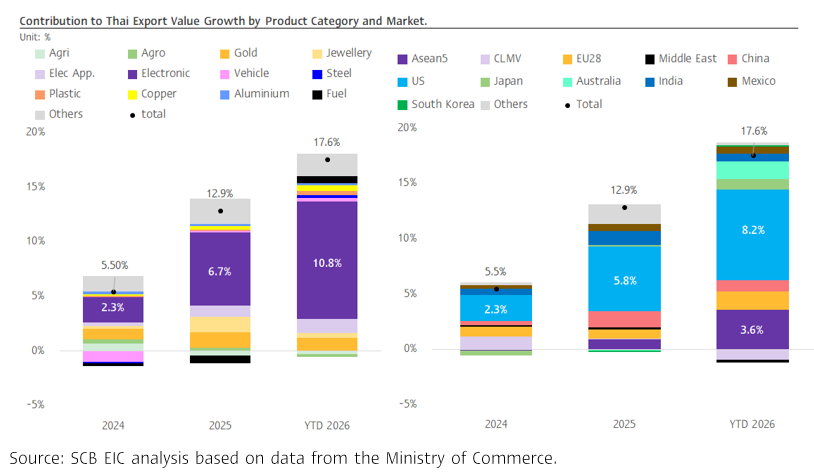
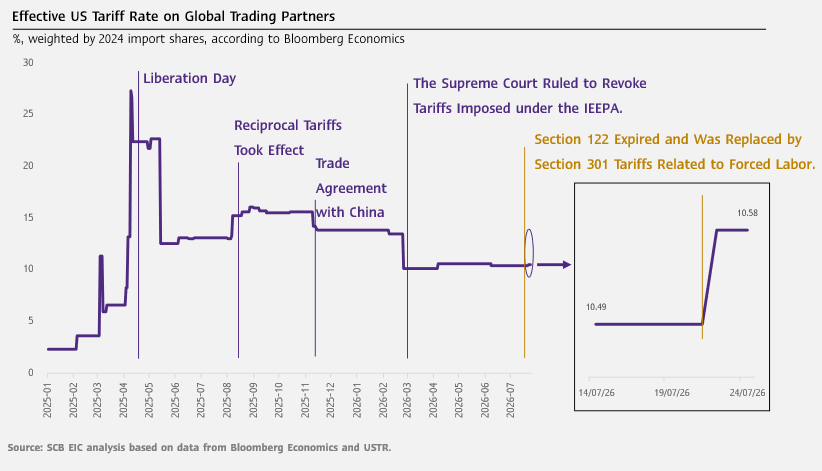
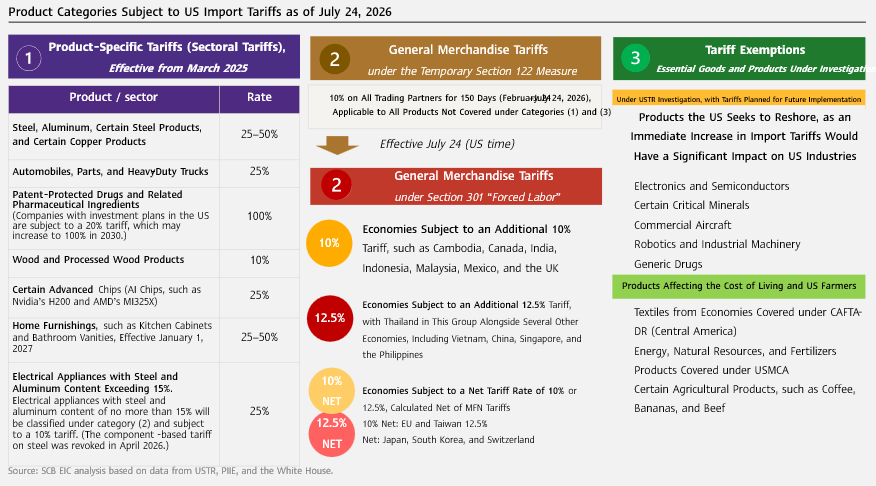
The US Began Imposing Section 301 Tariffs Related to Forced Labor, with Thailand Subject to a 12.5% Tariff.
|
Import value in June 2026 expanded far more rapidly than exports and reached its highest level in five years. Import value stood at USD 41,190.6 million, expanding by 50.3%YOY, compared with 35.1% in the previous month, and significantly exceeding expectations (SCB EIC forecast: 40.4%; Reuters Poll median: 37.1%). Key import categories this month were: (1) raw materials and intermediate goods, which expanded strongly by 71.2% (CTG: 29.4%). Imports of equipment and electrical and electronic components surged by 124.1% (CTG: 13.1%) for use in export production and domestic consumption, while gold imports rose by 191.7% (CTG: 7.2%); (2) capital goods, which expanded by 42.7% (CTG: 12.4%). Imports of electrical machinery and components, and computers, equipment, and components increased by 64.1% and 52.8%, respectively (CTG: 6.6% and 2.2%), in line with rising investment in technology-related industries such as data centers; and (3) fuel products, which expanded strongly by 39.5% (CTG: 5.3%), although growth slowed markedly from the early stages of the war, when imports surged by 129.3% and 94.6% in April and May, respectively (Figures 5 and 6).
The trade balance remained in a large deficit this month, with gold imports exerting significant pressure. Although pressures from the war have begun to ease, risks from oil prices remain elevated.
The customs-basis trade balance recorded a deficit of USD -6,534.7 million in June 2026, larger than market expectations (SCB EIC forecast and Reuters Poll median: USD -4,000 million). Although the trade deficit improved from USD -10,021.3 million in April, when it was severely affected by the Middle East war, it remained wider than the USD -5,711.4 million deficit recorded in May.
SCB EIC assesses that the wider trade deficit this month was driven primarily by the sharp acceleration in gold imports rather than by the direct impact of the Middle East war. This is reflected in the trade balance excluding gold, which recorded a deficit of only USD -3,924.1 million, improving from deficits of USD -4,353.5 million and USD -9,462 million in May and April, respectively. In H1, Thailand recorded a cumulative trade deficit of USD -31,744 million.
Looking ahead, the trade balance remains at risk of further deterioration as the Middle East war has intensified sharply, pushing crude oil prices back to around USD 100 per barrel. This risk is particularly significant for Thailand, given its high net energy import dependence of around 8-10% of GDP.
Figure 5: Electronic Equipment and Components and Capital Goods Were the Main Import Categories in H1/2026, while China and Taiwan Were the Key Import Markets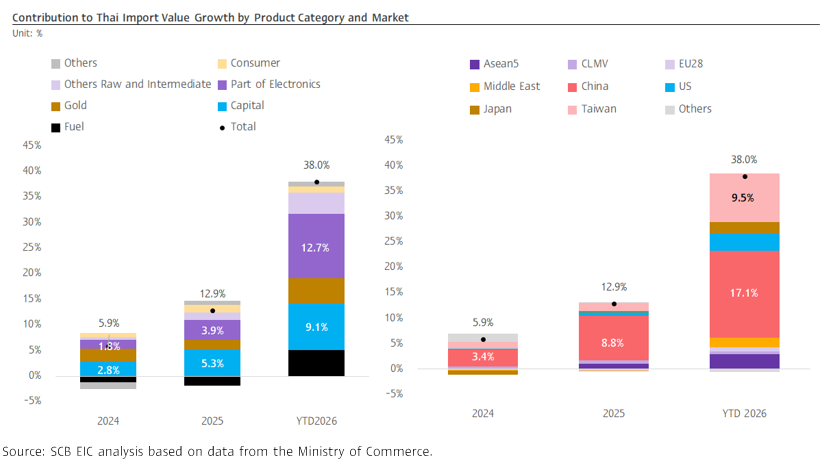
Figure 6: Thai Export and Import Value by Product Category and Key Markets