Thai Exports in April 2026 Surged, Supported by AI-Driven Demand, but the Trade Balance Recorded a Historic Deficit as Import Growth Nearly Doubled.
SCB EIC views that Thai export value this year is likely to expand more strongly at 7.8%, up from the previous forecast of 0.5%.
Thai exports in April 2026 continued to expand strongly.
Export value in April stood at USD 31,583 million, expanding by 23.1%, accelerating from 18.7% in the previous month and exceeding expectations (SCB EIC estimated 16.2%, while the Reuters Poll median was 17.3%). Seasonally adjusted export value expanded by 3.8%MOM_SA. Overall, Thai export value during the first 4 months of 2026 continued to expand by 18.9% (Figures 1 and 2).
Exports in April continued to be supported by electronic products, particularly shipments to the US, and additional support from agricultural exports.
(1) Electronic product exports continued to expand strongly by 64.6% this month, accelerating further from 43.8% in the previous month. This product group continued to benefit from the electronics upcycle, as well as the global expansion trend in investment in the electronics industry and data centers. This was reflected in exports of this product group to 13 out of Thailand’s 15 key trading partners continuing to grow well. Meanwhile, export data from regional economies that are key producers in the supply chain for this product group, such as South Korea, Japan, Vietnam, Singapore, and Malaysia, also recorded double-digit growth. Electronic product exports contributed 13.2% to Thai export growth this month, accounting for more than half of the total export growth of 23.1%.
(2) Exports to the US expanded strongly by 44.2%, continuing from 41.9% in the previous month, particularly electronic products, which surged by 93.8%. Meanwhile, other product groups excluding electronics expanded by 11.7%, reflecting demand for Thai products in the US market, as well as accelerated production and exports after US import tariffs declined. The US government is currently studying measures to impose tariffs under Section 301 on key trading partners, including Thailand, to raise tariff rates back close to previous levels. Exports to the US contributed 8.7% to export growth this month, out of total export growth of 23.1%.
(3) Agricultural product exports returned to strong growth of 17.9% after contracting for 7 consecutive months. The main support came from exports of fresh/chilled/frozen/dried fruits, which expanded by 74.3% after contracting by -9% in the previous month, particularly fresh durian exports, which surged by more than 109.5%. This was partly due to a low base effect. Exports of fresh/chilled/frozen/dried fruits contributed 2.1% to Thai export growth this month, out of total export growth of 23.1%.
Exports to the Middle East (ME 15) rebounded in April, driven by jewelry and precious stones exports.
Thai exports to the Middle East returned to growth of 19.3% in April, following a sharp contraction of -57.1% in the previous month. However, this was driven by a surge in jewelry and precious stones exports, which expanded by as much as 1,157.1%, particularly to the UAE market. Excluding this product category, exports to the Middle East would still have contracted sharply by -39.7%.
Imports surged by 45%, the highest growth in nearly 5 years, while the trade deficit reached a new record high.
Import value in April stood at USD 41,604.3 million, expanding by 45%, accelerating from 35.7% in the previous month. This marked the highest growth in 59 months and exceeded expectations (SCB EIC estimated 37.7%, while the Reuters Poll median was 30.1%). Overall, import value during the first 4 months of 2026 continued to expand by 35.7%, with this month’s growth driven by the following factors (Figures 3 and 4).
(1) Raw materials and intermediate goods expanded strongly by 38.7%, although slowing by nearly half from 64.4% in the previous month. Imports in this category contributed 17.1% to import growth this month, out of total import growth of 45%. Key products included electrical and electronic equipment components, particularly electrical circuit boards, which expanded by more than 121.8% and 133.8%, respectively (CTG: 14.6% and 13.1%). Part of the increase in imports of electrical and electronic equipment components reflected demand for upstream and midstream inputs for production and exports, requiring Thailand to import from key producers, particularly China and Taiwan, which expanded by 76.9% and 188.8%, respectively.
(2) Fuel products expanded strongly by 128.6% after contracting for 7 consecutive months, contributing 16.4% to total import growth this month, out of overall import growth of 45%. The key product was crude oil, which surged by more than 169.3% (CTG: 14%), driven by the Middle East conflict, which pushed up global oil prices.
(3) Capital goods expanded by 32.8%, accelerating from 28.3% in the previous month. Imports in this category contributed 8.9% to Thai import growth this month, out of total import growth of 45%. Key products included electrical machinery and parts, and computers, equipment and parts, which expanded by 65.4% and 26.4%, respectively (CTG: 5.9% and 1.4%). This may partly reflect Thailand’s limited capacity to produce capital goods in this category, while rising investment trends in advanced technology industries, such as data centers, have increased demand for capital goods imports in machinery and technology categories. This was particularly evident in imports from China, which expanded by 49.5% and accounted for 53.3% of Thailand’s total capital goods import value this month.
The customs basis trade balance recorded a deficit of USD -10,021.3 million this month, the highest on record and slightly larger than expected (SCB EIC estimated USD -9,700 million, while the Reuters Poll median was USD -5,000 million). Thailand’s cumulative trade deficit during the first 4 months of 2026 stood at USD -19,497.9 million (Figure 5).
SCB EIC revised up its 2026 export outlook to 7.8%, but import growth is expected to be higher at 15.8%.
SCB EIC views that Thai export value this year is likely to expand more strongly at 7.8%, up from the previous forecast of 0.5%, despite still-high uncertainty from the Middle East conflict. The main reasons are as follows:
1) The 2026 global trade forecast has been revised upward. The WTO and IMF raised their global trade volume growth forecasts to 1.9% and 2.8%, from 0.5% and 2.6%, respectively. The WTO noted that AI-related trade is likely to continue growing, with Asia benefiting significantly. In addition, the impact of US import tariffs is likely to be lower than previously expected (Figure 6, left).
2) Thai export value during the first 4 months of this year expanded strongly by 18.9%, consistently exceeding expectations. This was supported by exports of AI-related products, such as electronic products, which expanded by more than 57% (CTG: 10.7%). In addition, rising global gold demand amid heightened uncertainty helped lift Thailand’s unwrought gold export value by 50.8% during the first 4 months of the year (CTG: 2.2%) (Figure 6, right).
3) Thai electronic product exports are likely to continue expanding well in the period ahead, accounting for 21% of total export value in 2025. This will be supported by the global electronics industry upcycle and continued expansion in data center investment, with Thailand becoming an important part of the global supply chain for electronic product manufacturing. This view is consistent with the WTO (Figure 7).
The Ministry of Commerce estimates that Thailand’s export value in 2026 will fall within a range of -3% to 8%, while risks from US tariff barriers remain a key factor to monitor.
However, SCB EIC revised up its import value forecast for this year to 15.8% (from the previous forecast of 9.0%), driven by the following factors: 1) Imports during the first 4 months expanded sharply by 35.7%, particularly raw materials and intermediate goods, which grew by 51.3% (CTG: 21.5%). 2) Imports of raw materials, intermediate goods, and capital goods are likely to continue expanding, in line with the sustained strong growth in electronic product exports and rising demand from technology industries such as data centers. 3) Fuel imports are expected to increase significantly in line with global energy prices following the impact of the Middle East conflict, consistent with the import price index, which rose by 10.2%, particularly crude oil prices, which surged by 47.5% in March (April figures have not yet been released).
Figure 1: Thai Export Value by Product Category and Key Markets.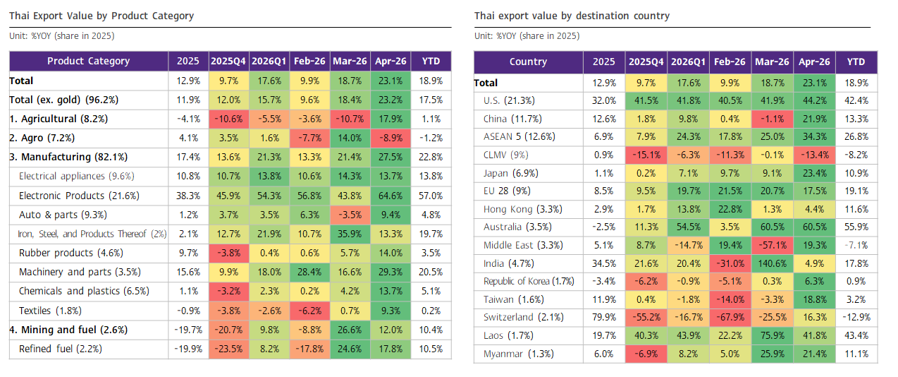
Source: SCB EIC analysis based on data from the Ministry of Commerce.
Figure 2: Electronic Products Were the Key Export Category in April 2026.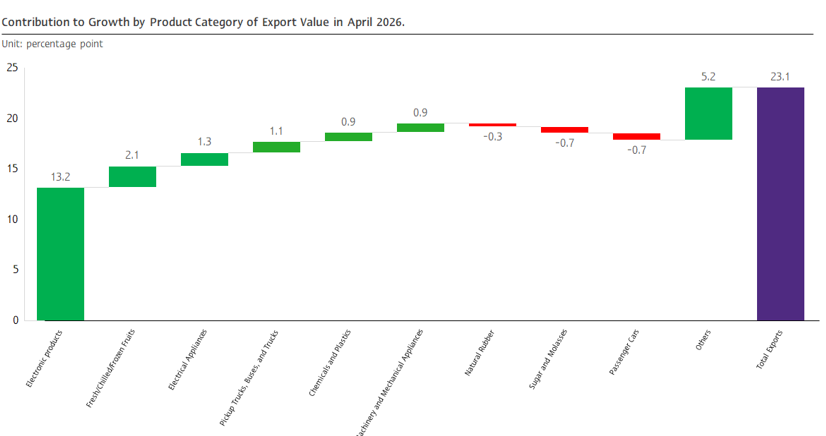
Source: SCB EIC analysis based on data from the Ministry of Commerce.
Figure 3: Thai Import Value by Product Category and Key Markets.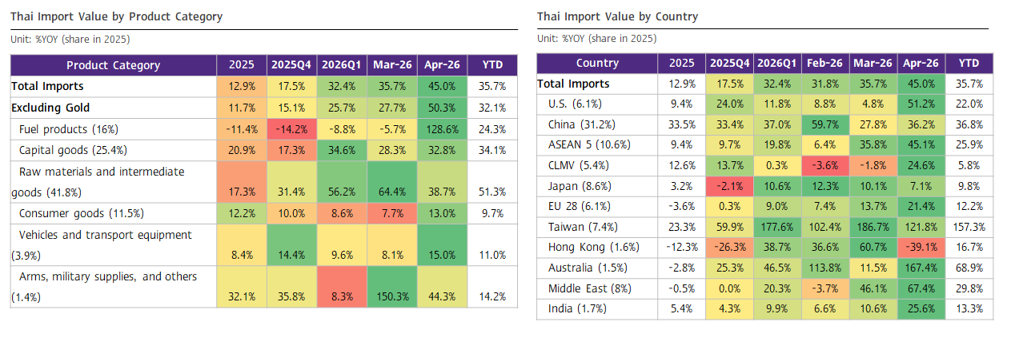
Source: SCB EIC analysis based on data from the Ministry of Commerce.
Figure 4: Electronic Equipment Components and Crude Oil Were the Key Import Categories in April 2026.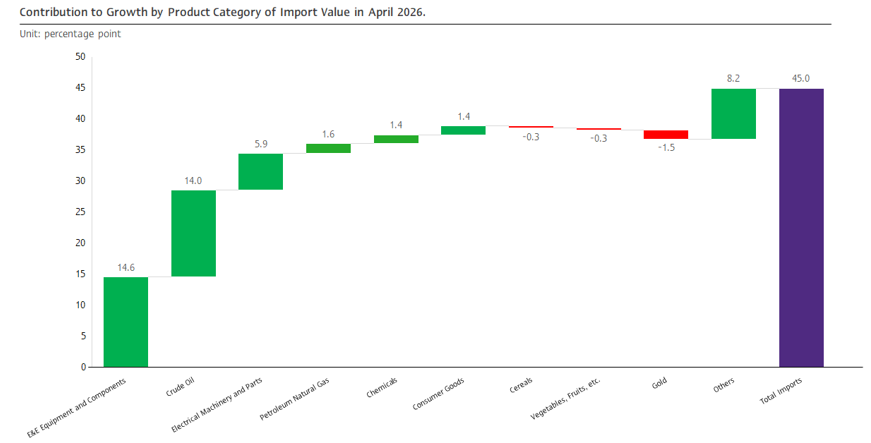
Source: SCB EIC analysis based on data from the Ministry of Commerce.
Figure 5: Thailand Recorded a Historic High Trade Deficit in April 2026.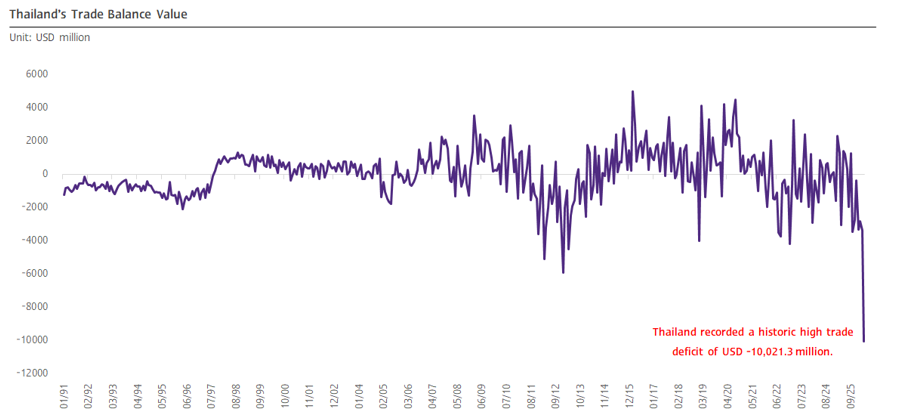
Source: SCB EIC analysis based on data from the Ministry of Commerce.
Figure 6: SCB EIC Revised Up Its 2026 Thai Export Value Growth Forecast to 7.8% (from the Previous Forecast of 0.5%), Driven by Improved Global Trade Projections and Stronger-Than-Expected Thai Export Growth in the First 4 Months.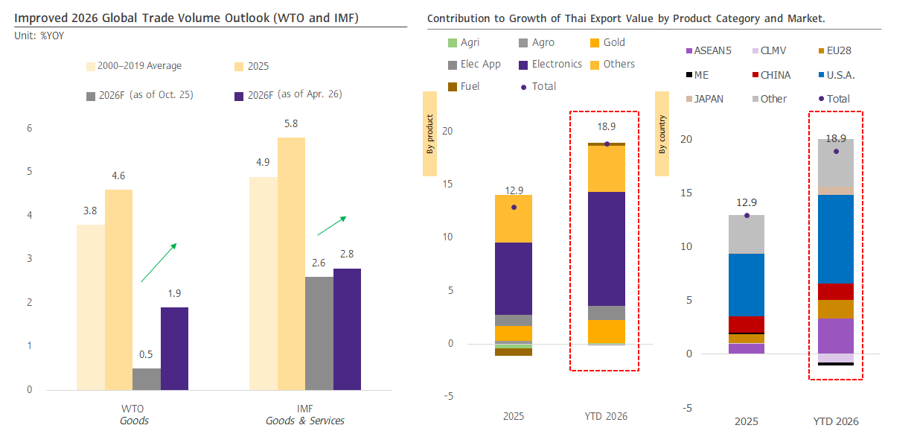
Source: SCB EIC analysis based on data from the Ministry of Commerce and WTO.
Figure 7: Electronic Exports Continue to Support Asia Despite Higher Energy Prices, While Electronics Demand Continues to Expand in Line with Big Tech Investment.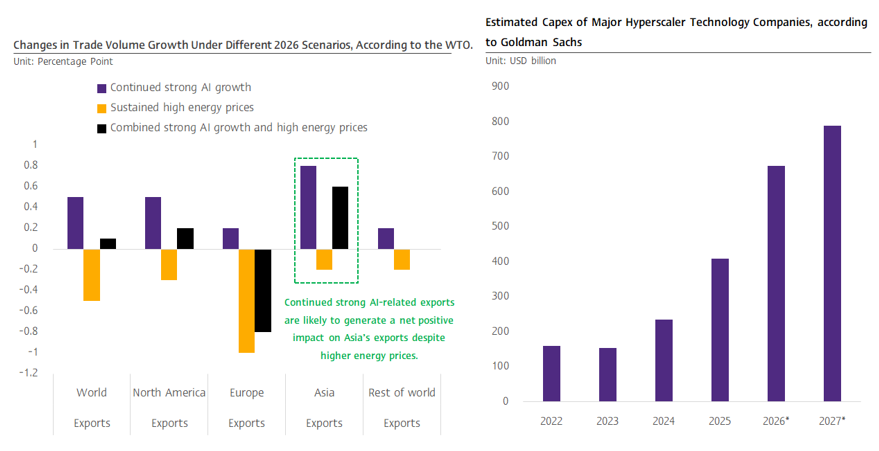
Source: SCB EIC analysis based on data from WTO, FactSet, and Goldman Sachs.