MPC holds policy rate at 1% as expected; SCB EIC sees the rate potentially remaining on hold through 2027.
SCB EIC expects the Thai economy to grow by only 2.1% next year, while headline inflation should gradually decline as supply-side pressures ease.
Key summary
|
The MPC unanimously voted to maintain the policy rate at 1.0%, viewing it as sufficiently accommodative to support Thailand’s slow and uneven economic growth. Households and SMEs remain vulnerable, while recent inflation reading has been lower than expected but is likely to rise over the remainder of the year due to supply-side factors. Looking ahead, the MPC will monitor the Middle East war, international trade protectionist measures, and inflation risks.
Figure 1: Thailand’s economic growth remains uneven and highly import-dependent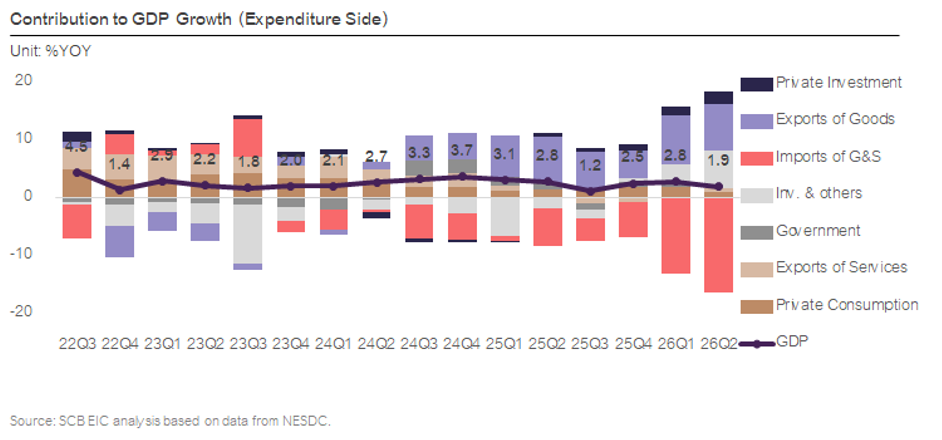
The Thai economy grew broadly in line with the MPC’s assessment, while inflation was lower than expected.
- The Thai economy expanded broadly in line with the previous projection in Q2, with growth concentrated (Figure 1) in exports related to AI technology and digital investment. However, the benefits to the Thai economy remain limited due to high import dependence, with limited potential to increase employment of Thai workers.
- Thailand’s headline inflation in Q2 was lower than the MPC had assessed, mainly due to a larger-than-expected decline in actual energy prices (Figure 2) and weaker-than-expected cost pass-through by firms. Looking ahead, the MPC expects headline inflation to slightly exceed the target range in Q4-2026 and Q1-2027, driven by fresh food prices that may rise due to the impact of El Niño.
- Financial conditions for SMEs and vulnerable groups remain tight, in contrast to stronger loan growth among large corporates. In this meeting, the MPC also added in its Press Statement that it “encourages financial institutions to provide greater support to vulnerable groups and potential SMEs through targeted financial measures.”
- The MPC assesses that the current policy rate is appropriate, as the costs of a rate cut under current conditions may outweigh the benefits. The current situation still requires fiscal policy and targeted financial measures to mitigate the impact of the situation in the Middle East and address tight financial conditions among retail borrowers and SMEs.
Figure 2: Thai inflation slowed in line with energy prices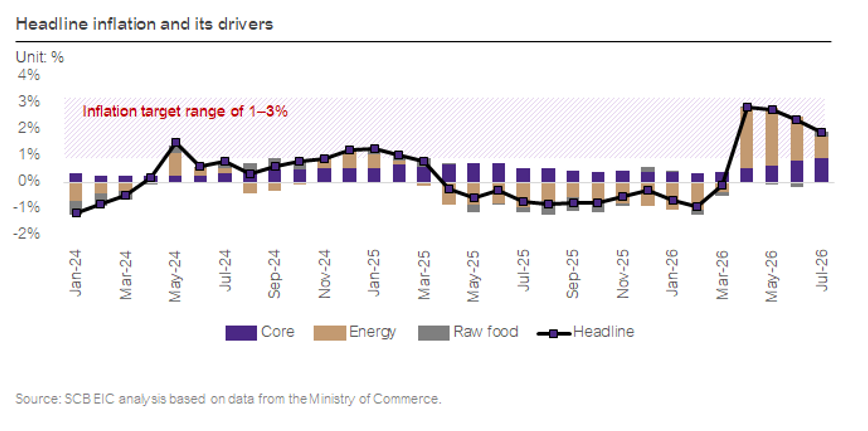
IMPLICATIONS
SCB EIC expects the MPC to hold the policy rate at 1% throughout 2026–2027.
- The MPC is expected to hold the policy rate at 1%, balancing risks to inflation, economic growth, and financial stability.
- A rate cut may not help address specific problems among vulnerable groups, particularly households and SMEs facing tight financial conditions due to rising credit risks. Targeted financial measures would therefore be a more effective approach to addressing these problems.
- A rate hike has become less necessary, particularly as inflation risks in Thailand have somewhat declined. While the interest rate differential between Thailand and the U.S. may affect the baht at times, the BOT still has the capacity to manage excessive FX volatility, supported by its high level of international reserves.
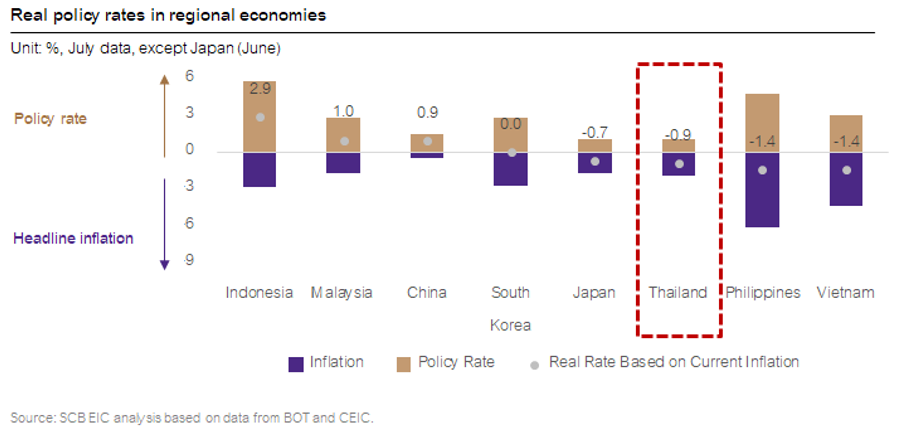
- Thailand’s real policy rate is not the lowest in the region. After adjusting the policy rate for headline inflation, Thailand’s real policy rate remains higher than those of regional peers, particularly some economies facing higher inflation than Thailand (Figure 3).
- The MPC is likely to hold the policy rate at 1% through 2027. SCB EIC expects the Thai economy to grow by only 2.1% next year, while headline inflation should gradually decline as supply-side pressures ease. A sufficiently accommodative monetary policy stance, together with targeted financial measures, would therefore be appropriate to support the Thai economy, which remains fragile across several sectors.
Figure 3: Thailand’s real policy rate is not the lowest in the region