Golden Age for Japanese Electrical Appliances Ending
Japanese electric appliances are losing their market share to their Chinese and Korean rivals, especially in emerging markets like China and ASEAN, including Thailand. As a result, manufacturers and distributors of Japanese brands are suffering decreasing revenue. Japanese electrical appliances losing market share in Thailand include televisions and washing machines, while there are signs that Japanese refrigerators have also begun to suffer.
Author: Lapas Akaraphanth
|
Highlight
|
The golden age of Japanese electrical appliance manufacturers has ended due to lower market share in both global market and in Thailand. Japanese brands, once the unmatched leader of the electrical appliance market, are now losing revenue due to their plummeting competitiveness in both the global market and in Thailand, as Korean and Chinese brands outperform them. Since Thailand has long been a production hub for Japanese brands, accounting for 54% of the production volume of electrical appliances in Thailand, this has resulted in an export slowdown in the electrical appliances sector. In 2015 overall exports in this sector dropped by 5%. For example, there was a 3.3% decrease in the exports of refrigerators, of which exports to major markets such as Japan, Malaysia, Indonesia, and the Philippines decreased by over 10%.
Market share of Japanese brands in global market subsided. According to a report by Japan’s Ministry of Economy, Trade, and Industry in 2014, the market share of Japanese brands in the global market has dropped to a very low level. In 2013, Japanese air conditioners and refrigerators had total market shares at only 20% and 15% respectively, taken over by Chinese and Korean brands. As a consequence, revenue of major players in the electrical appliances sector has dropped continuously. Some Japanese players like Sharp have suffered a revenue loss of 16% over the past 6 years, forcing it to sell its headquarter building. And there is a possibility that Sharp’s electrical appliances business will merge with Toshiba’s, which is also in the process of restructuring due to a 19% decrease during the same period. Toshiba already raised the white flag in the television manufacturing war. And Panasonic left the appliance sector even before the crisis hit, selling Sanyo to Haier in 2012. Panasonic has made it clear that the company has not been an electrical appliance maker since 2013. The departure of Japanese brands from the electrical appliances business has become a significant business phenomenon in Japan and not-very-surprising news since 2012 (#Datsukadenka or 脱家電化). On the other hand, the performance of Chinese brands was outstanding. For example, Haier’s yearly growth was as high as 18% during the same period. It was also reported that the Chinese company is planning to take over GE’s electrical appliances business.
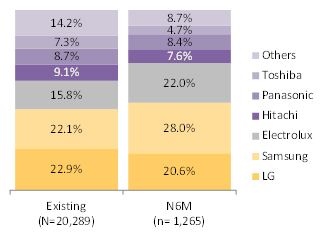
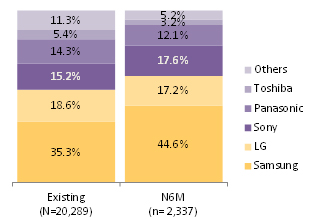
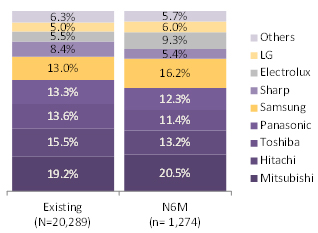
Japanese brands’ market share in Thailand dropped. EIC conducted a survey on the possession of major electrical appliances with 20,289 respondents in January 2016 and found that the share of people using Korean televisions and washing machines were as high as 54% and 45%, respectively. Moreover, the survey also suggested that respondents were planning to buy more Korean brands. Respondents considering purchases in the next six months were planning to purchase Korean brand televisions and washing machines, accounting for 62% and 49%, respectively. Although 62% of the respondents were currently using Japanese refrigerators, the segment was very fragmented with four different brands holding similar market shares, making it difficult to maintain their positions. In addition, some 22% of surveyed users were planning to purchase Korean refrigerators within the next six months, which was more than the possession rate of 18% at the time of the survey. According to these figures, Japanese refrigerator manufacturers are forced to continue fighting in a fierce war against the Korean brands in order to survive. In addition, the declining popularity of Japanese brands has inevitably affected the income of Japanese businesses in Thailand and their partners. In 2014 the gross revenue of Japanese businesses in Thailand plummeted by 9% compared to that of Chinese and Korean businesses in Thailand, which grew by 35% and 6% respectively.
Japanese brands have been losing competitiveness as they could not win emerging markets as well as Korean and Chinese brands. The year 2000 marked the prosperity of emerging markets like Southeast Asia and China, which experienced a rapid growth of their middle class populations. This created an opportunity for Korean and Chinese electrical appliance manufacturers to develop their competitiveness with prices and quality meeting the demand of these new markets. Their success in doing so enabled both of them to gain higher market share than their Japanese rivals. It is also worth noting that Japanese brands are more expensive, since they focus more on exceptionally high quality to satisfy the specific needs of its home market in Japan. This was the key strategy in maintaining market share in the electrical appliances sector before 2000, when the major markets were confined to just the US, Europe, and Japan. Market conditions then were the main driver forcing manufacturers to manufacture products meeting the specifications of their home markets. For example, built-in electrical appliances were needed in Europe and larger-sized electrical appliances in the US
 |
|
|
|

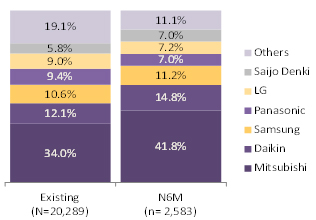
| Figure 1: Current possession and television purchase plans in the next six months | Figure 2 : Current possession and air conditioner purchase plans in the next six months | |
 |
|
|
|
Source: EIC Appliance Survey (January 2016) |
Source: EIC Appliance Survey (January 2016) |
| Figure 3: Current possession and refrigerator purchase plans in the next six months | Figure 4: Current possession and washing machine purchase plans in the next six months | |
 |
|
|
|
Source: EIC Appliance Survey (January 2016) |
Source: EIC Appliance Survey (January 2016) |