War dragged March exports to the Middle East into a sharp contraction, while overall exports still posted strong growth. Imports surged to the highest level in more than four years.
EIC views that Thai export value is likely to continue expanding before slowing significantly after the global economy is fully affected by the war.
Overall, Thai exports in March 2026 continued to expand robustly.
Export value reached USD 35,157.1 million, marking strong growth of 18.7%, up from 9.9% in the previous month and higher than expectations (SCB EIC estimated 11.6%, while the Reuters Poll median was 9.8%). Seasonally adjusted export value expanded by 4.9%MOM_SA. Overall, Thai export value in Q1/2026 continued to grow by 17.6%.
Exports this month were supported by electronic products and a renewed wave of front-loading shipments to the US, following preparations for new tariff measures under Section 301.
(1) Exports of electronic products expanded strongly by 43.8%. Key products included teleprinters, telephone sets and parts; transmission apparatus; printed circuits; and computers, equipment and parts, which expanded by 34.2%, 166.6%, 129.1%, 43.8%, and 34.2%, respectively. This product group continued to be supported by the electronics upcycle, as well as the global expansion of investment in the electronics industry and data centers. This was reflected by exports of this product group to 11 out of Thailand’s 15 key trading partners continuing to expand well. Electronic products contributed 9.2 percentage points to Thai export growth this month, accounting for nearly half of the total export growth of 18.7%.
(2) Exports to the US expanded strongly by 41.9%, continuing from 40.5% in the previous month. In particular, exports of electronic products not yet subject to additional US import tariffs surged by 64.2%, while other products excluding electronics grew by 24.8%. This reflected US demand for Thai products, as well as accelerated production and shipments after the Supreme Court ruled on February 20 that the US government had no authority to raise import tariffs under IEEPA. As a result, the US reduced the tariff rate on Thai products from 19% to 10%, the new rate applied equally to other trading partners, temporarily effective until July 24. Meanwhile, the US government is studying the possibility of imposing tariff barriers under Section 301 on major trading partners worldwide, including Thailand, to raise tariff rates closer to previous levels. Exports to the US contributed 8.8 percentage points to export growth this month, out of total export growth of 18.7%. Exports from regional economies to the US also expanded well this month, such as Vietnam (28.4%), South Korea (47.3%), and Taiwan (124%).
(3) Exports of articles of jewellery and parts expanded sharply by 187.2%, accelerating significantly from 34.4% in the previous month. The main support came from exports to India, which surged by 3,155.4% and accounted for nearly 80% of Thailand’s total exports in this product category this month. Articles of jewellery and parts exports contributed 3.9 percentage points to Thai export growth this month, out of total export growth of 18.7%.
Exports to the Middle East (ME 15) contracted sharply due to the impact of the war in Iran.
Thai exports to the Middle East contracted sharply by -57.1% in March, with contractions in the region’s three major markets: UAE (-67.1%), Turkiye (-20.5%), and Saudi Arabia (-55.5%). Exports also declined across five key products: automobiles, equipment and parts (-53.5%); jewelry and precious stones (-67.5%); air conditioners and parts (-41.4%); rubber products (-55.1%); and canned and processed seafood (-47.5%).
Imports accelerated to the highest level in 51 months, particularly electrical appliance and electronics parts and components, which are expected to have been imported for production and export.
Import value in March stood at USD 38,496.6 million, expanding by 35.7%, the highest growth in 51 months. This accelerated from 31.8% in the previous month and exceeded expectations (SCB EIC estimated 24.2%, while the Reuters Poll median was 20.3%). Overall, Thai import value in Q1/2026 continued to expand by 32.4%.
Major imports this month included the following (Figures 3 and 4):
(1) Raw and intermediate goods expanded sharply by 64.4%, accelerating from 53.3%. Imports in this category contributed 26 percentage points to import growth this month, more than half of total import growth of 35.7%. Key products included gold and electrical appliance and electronics parts and components, especially printed circuit boards, which expanded by 181.6% and 129.3%, respectively (CTG: 9.4% and 13.3%). Part of the increase in imports of electrical appliance and electronics parts and components reflected demand for upstream and midstream inputs for production and export. As a result, Thailand had to import these products from key producers such as China and Taiwan (15.8% and 343.7%, respectively).
(2) Capital goods expanded by 28.3%, slowing from 49.3% in the previous month. Imports in this category contributed 7.7 percentage points to Thai import growth this month, out of total import growth of 35.7%. Key products included electrical machinery and parts, and computers, equipment and parts, which expanded by 82.7% and 25.3%, respectively (CTG: 6.7% and 1.2%). This may partly reflect Thailand’s limited domestic production capacity for these types of capital goods, while rising investment in technology industries such as data centers has increased demand for imports of capital goods in machinery and technology-related categories.
The trade balance (customs basis) this month continued to record a deficit of USD -3,339.5 million, larger than expected (SCB EIC estimated USD -2,150 million, while the Reuters Poll median was USD -1,120 million). Thailand’s cumulative trade deficit in Q1 stood at USD -9,476.6 million.
Thailand’s trade balance is likely to deteriorate further going forward.
SCB EIC views that Thai export value is likely to continue expanding before slowing significantly after the global economy is fully affected by the war. Exports are expected to be supported by electronic products, as reflected by high-frequency export data from South Korea in the first 20 days of April, which continued to expand well by 49.4%, particularly electronics-related products such as semiconductors, which surged by 182.5%.
The Ministry of Commerce stated that Thai electronic products have become an important part of the global supply chain and will be a key factor supporting Thai exports going forward. Meanwhile, exports will face pressure from shipments to the Middle East and a likely slowdown in the global economy due to the war. The Ministry of Commerce estimates that Thai export value in 2026 will expand by 3% in the base case, with the best-case scenario at 8% and the worst-case scenario at -3%.
In contrast, SCB EIC views that Thai import value is likely to continue accelerating, particularly imports from China and imports of electronics-related intermediate goods, which had already expanded strongly earlier. In addition, the expected acceleration in Thai import value going forward will likely reflect the sharp increase in global energy prices following the war in the Middle East, as Thailand is a net energy importer, with net energy imports accounting for around 8% of GDP. Thailand’s trade balance this year is therefore expected to deteriorate.
Figure 1: Thai Export Value by Product Category and Key Markets.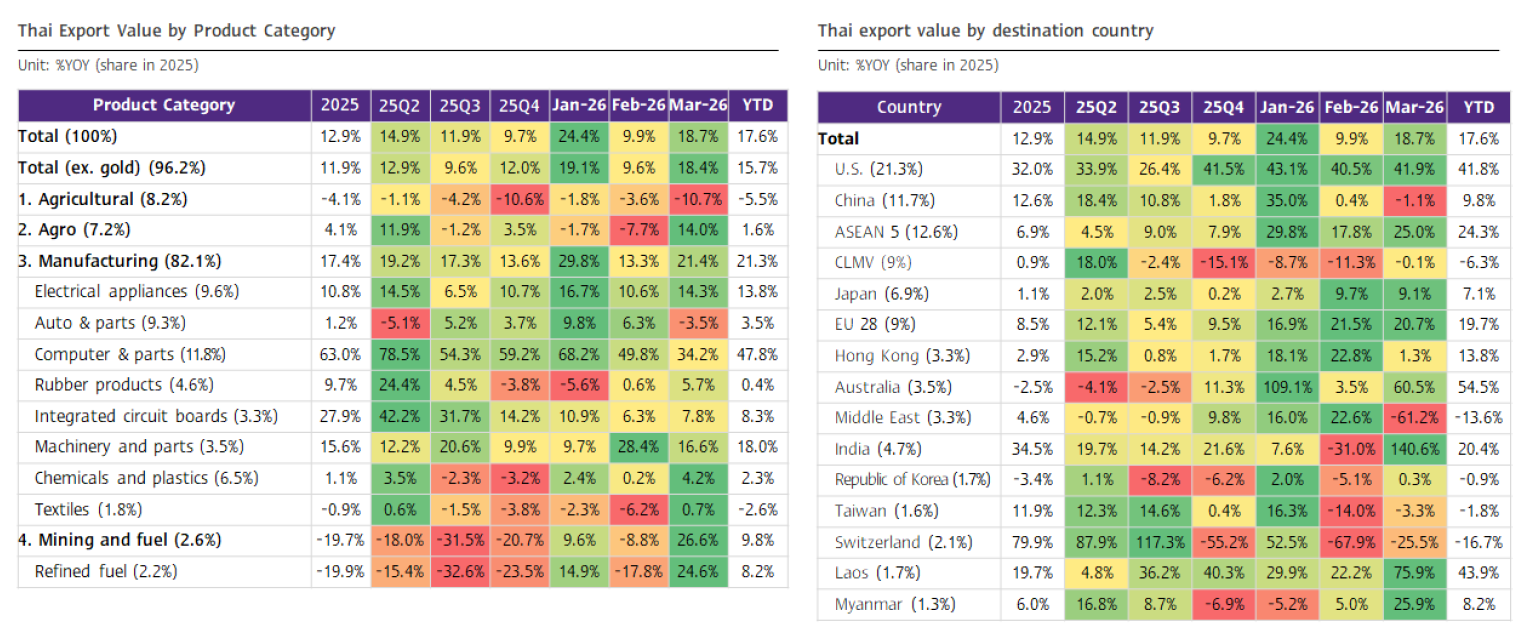
Source: SCB EIC analysis based on data from the Ministry of Commerce.
Figure 2: Electronic products remained the key export products in March 2026.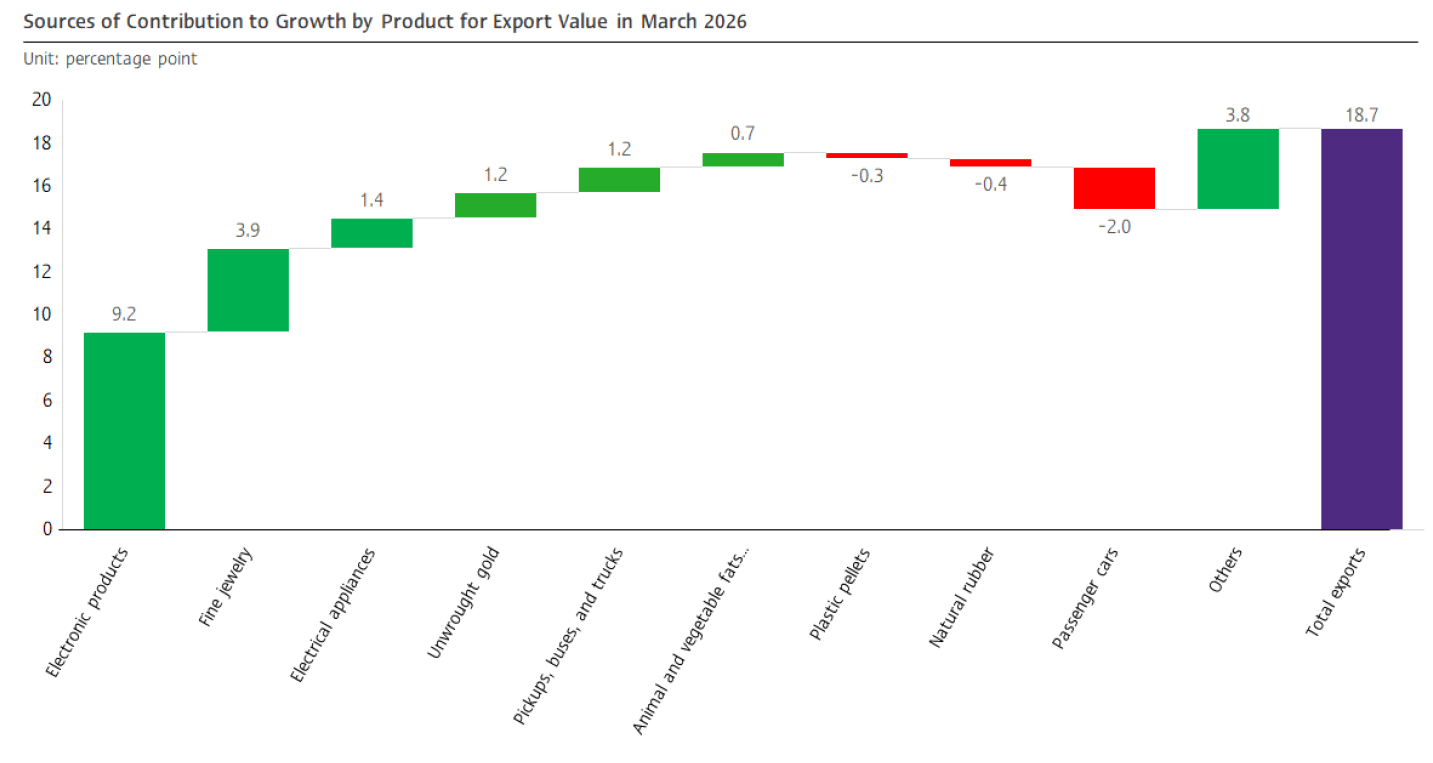
Source: SCB EIC analysis based on data from the Ministry of Commerce.
Figure 3: Thai Import Value by Product Category and Key Markets.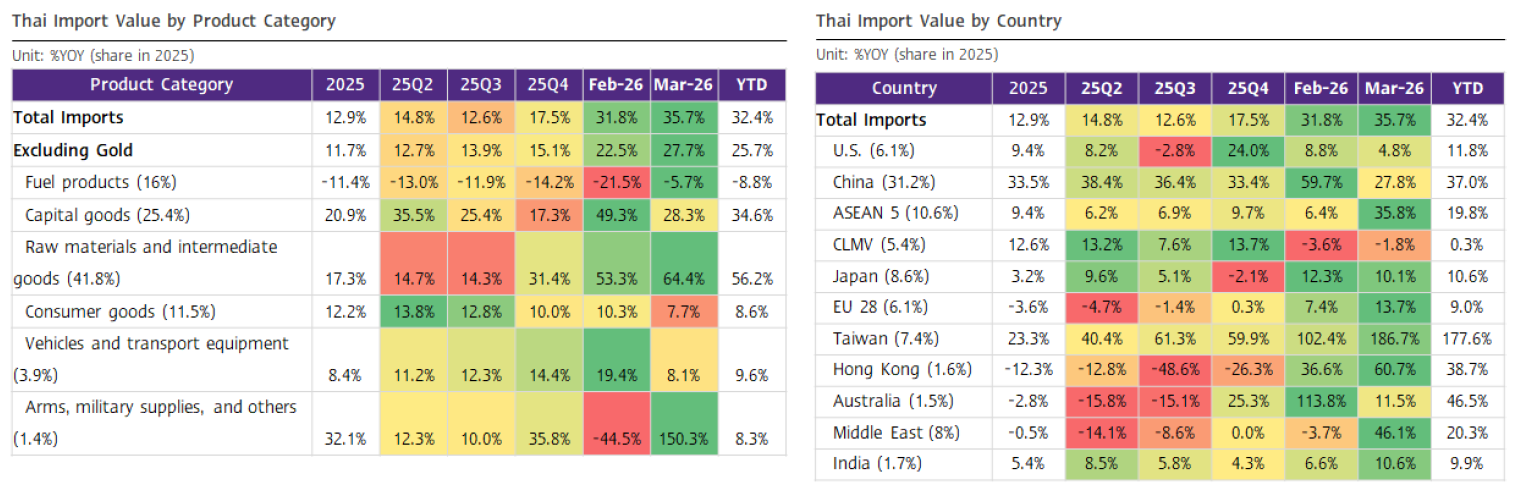
Source: SCB EIC analysis based on data from the Ministry of Commerce.
Figure 4: Electronics parts and components, gold, and electrical machinery were the key import products in March 2026.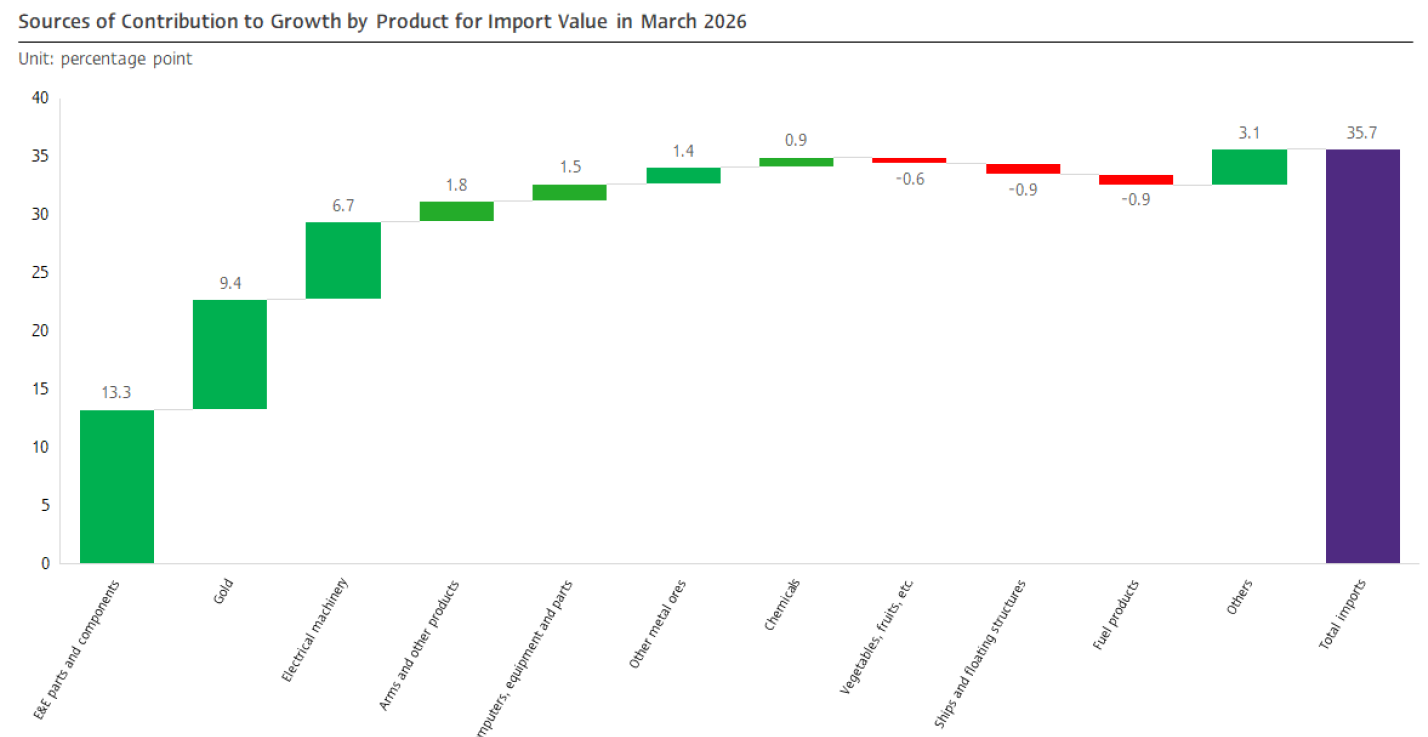
Source: SCB EIC analysis based on data from the Ministry of Commerce.