SHARE

Thai exports in January 2026 recorded the strongest growth in four years, but the outlook faces rising uncertainty from additional US tariff measures.

SCB EIC has revised Thai exports’ projection to return to expansion of 1.6% in 2026 (previously -1.5%).

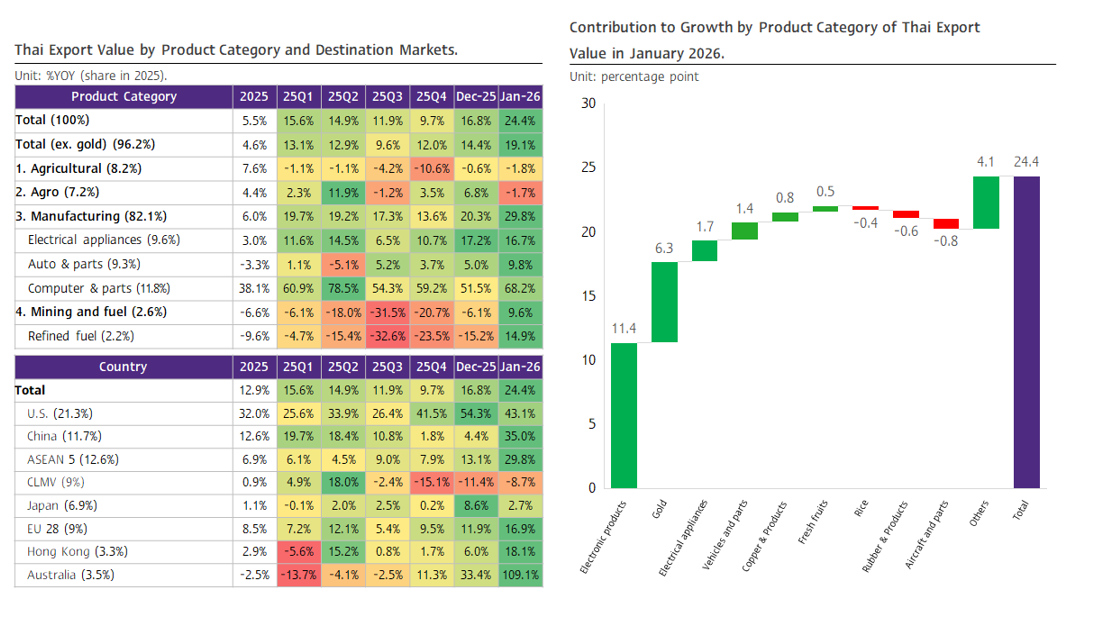
The value of Thai exports in January 2026 stood at USD 31,573.1 million, expanding by 24.4%YOY — the highest growth rate in four years. This marked an acceleration from 16.8% in the previous month and was significantly higher than expectations (SCB EIC projected 8.5%, while the Reuters Poll median stood at 9.4%). On a seasonally adjusted basis, exports expanded by as much as 10.6%MOM_SA, continuing from 7.3%MOM_SA in the preceding month. Export performance this month was supported by two key drivers: (1) the global upcycle in electronics products, driven by AI-related investment trends and rising demand for associated products. Exports of electronic products surged by 67%, accelerating from 52.8% in the previous month and marking 22 consecutive months of expansion; and (2) unwrought gold exports expanded strongly by 136.2%, partly reflecting record-high gold prices during the month, supported by continued gold purchases by central banks and heightened demand for safe-haven assets amid elevated geopolitical risks. 
Overall, exports of electronic products and gold contributed as much as (CTG) 11.4% and 6.3%, respectively, to the total export growth of 24.4% in January.

Figure 1: Thai Export Value by Product Category and Key Markets.
trade-270226-01.png
Source: SCB EIC analysis based on data from the Ministry of Commerce.

Merchandise import value also recorded the highest expansion in four years, resulting in a substantial trade deficit for Thailand. The value of merchandise imports in January 2026 stood at USD 34,876.49 million, expanding by 29.4%YOY, compared with 18.8% in the previous month, and significantly exceeding expectations (SCB EIC projected 10.5%, while the Reuters Poll median was 10.3%).
The main imported categories were: (1) raw materials and intermediate goods, which expanded sharply by 50.3% (CTG = 20.5% out of total growth of 29.4%), particularly electrical and electronic equipment and components, as well as gold; and (2) capital goods, which grew by 29.5% (CTG = 7.7% out of 29.4%), especially electrical machinery and parts, and mechanical machinery and parts.
The customs basis trade balance in January 2026 recorded a deficit of USD -3,303.4 million, larger than market expectations (SCB EIC had projected USD -2,100 million, while the Reuters Poll median expected USD -2,030 million), marking the fourth consecutive month of trade deficit.

Special Topic: The Direction of US Tariff Barriers Following the US Supreme Court Ruling

(Data as of February 23, 2026)


The Supreme Court ruled that the Trump administration’s use of authority under the IEEPA to impose import tariffs was unlawful.

On February 20, 2026, the U.S. Supreme Court ruled by a 6–3 majority that the Trump administration did not have the authority to impose import tariffs under the International Emergency Economic Powers Act (IEEPA)[1]. The ruling followed a petition filed by a coalition of U.S. importing businesses to the U.S. Court of International Trade (CIT), seeking a judicial review of the administration’s authority to raise import tariffs during Q2/2025.

The ruling requires the US government to terminate the collection of import tariffs imposed under the IEEPA authority (effective February 23). These include: (1) reciprocal tariffs levied additionally on various trading partners at rates ranging from 10–50%, including Thailand, which was subject to an additional 19% tariff; and (2) tariffs imposed under emergency circumstances, such as those related to fentanyl smuggling (targeting Mexico, Canada, and China), as well as tariffs associated with domestic political issues in Brazil.

In addition, the US government is required to refund the import duties collected under these measures to US importers who had borne the additional tariff costs.
However, additional import tariffs imposed by the Trump administration under other legal authorities will remain in effect. These include product-specific tariffs implemented under national security provisions (Sec. 232), as well as tariffs on Chinese goods imposed during the Trump 1.0 administration under the unfair trade practices law (Sec. 301).


The Trump administration responded immediately by imposing a 15% across-the-board tariff on global imports under the authority of Sec. 122, effective for a period of 150 days.

The Trump administration had been aware of the U.S. Supreme Court’s stance since early November 2025, providing sufficient time to prepare contingency measures following the Court’s ruling. As a result, it was able to promptly announce a 15% uniform tariff on global imports (excluding most products already subject to product-specific tariffs) for a period of 150 days (Worldwide Tariff, as announced by President Trump on Truth Social).

This measure was implemented under Sec. 122 of the Trade Act of 1974, which authorizes the government to impose import tariffs of up to 15% on a global basis if the United States faces a serious balance-of-payments deficit or a rapid depreciation of the US dollar. The measure may remain in effect for up to 150 days and can be extended with legislative approval.

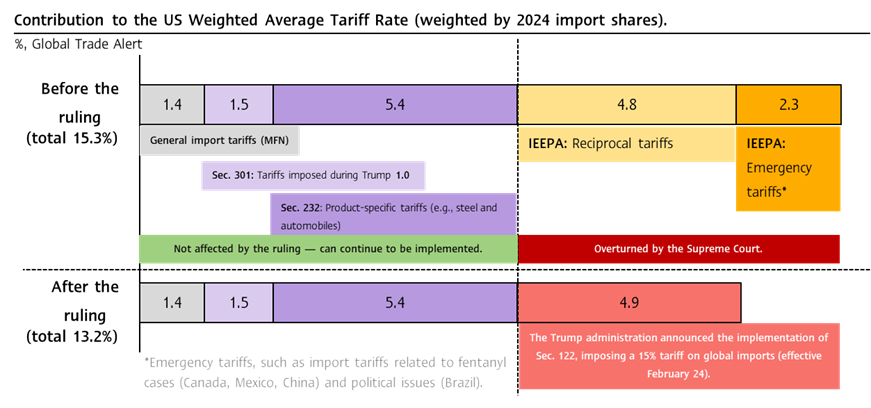
The recent increase in the US Worldwide tariff is expected to offset a substantial portion of the import tariffs previously imposed under the IEEPA that were revoked by the Supreme Court. According to an analysis by Global Trade Alert, the Court’s ruling would reduce the United States’ weighted average tariff rate from 15.3% to 8.3%. However, the implementation of a 15% Worldwide tariff would raise the weighted average tariff rate back to 13.2% (Figure 2), only slightly below the level prior to the Supreme Court’s decision.


Figure 2: The US Weighted Average Tariff Rate Will Decline Only Slightly After February 24.

trade-270226-2.png


Source: SCB EIC analysis based on data from The White House and Global Trade Alert.


Under the Worldwide tariff implemented by the US to replace the IEEPA authority, the average tariff rate imposed on Thai exports will decline only slightly.

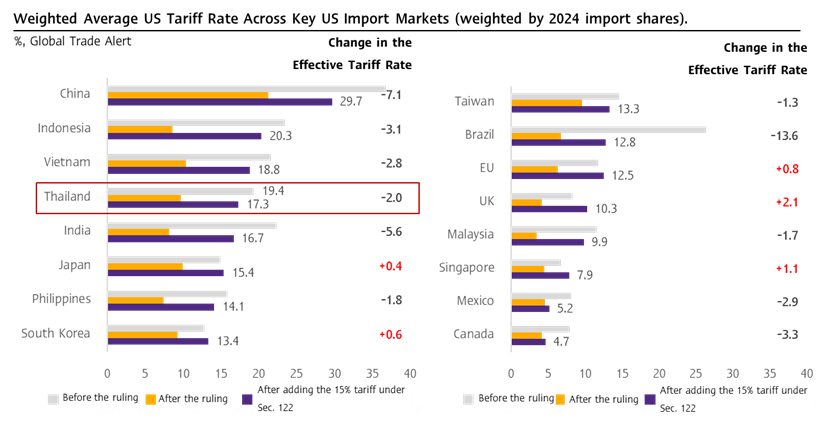
Although the overall U.S. import tariff rate has declined, the impact varies significantly across countries. The primary beneficiaries are those that had previously faced reciprocal tariffs above 15%[2] such as Brazil. In Brazil’s case, the average tariff rate is set to fall by as much as 13.6 percentage points, after having been subject to reciprocal tariffs of up to 50%.
For Thailand, which had been subject to a 19% reciprocal tariff, the change will reduce the average tariff rate by 2.0 p.p. Meanwhile, for the United Kingdom, which had successfully negotiated its tariff rate down to 10%, the new measure results in a 2.1 p.p. increase in its average tariff rate (as it had previously faced only a 10% reciprocal tariff) (Figure 3).


Figure 3: Countries Previously Subject to Reciprocal Tariffs Above 15% Will Temporarily Benefit.

trade-270226-3.png

Source: SCB EIC analysis based on data from Global Trade Alert.


Looking ahead, the Trump administration is likely to continue utilizing import tariffs under other legal authorities as a policy instrument.

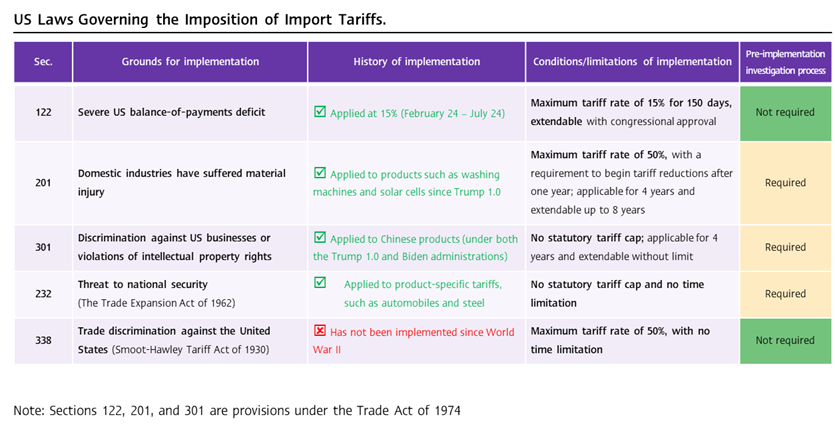
The U.S. government retains multiple legal instruments to impose import tariffs (Figure 4). One key mechanism is Section 301 of the Trade Act of 1974, which was employed by both the Trump 1.0 and Biden administrations to levy tariffs on a broad range of Chinese products. This provision could potentially serve as a longer-term alternative to reciprocal tariffs.
However, invoking Section 301 requires the administration to conduct formal investigations into alleged unfair trade practices by each trading partner. Such investigations typically take around 6–12 months before tariffs can be officially implemented. Notably, the U.S. has already initiated investigative procedures against China and Brazil and may launch similar probes into other countries it views as misaligned in trade relations. While the statutory process is time-consuming, it is possible that the administration could attempt to accelerate certain stages, potentially concluding proceedings within the next 150 days.


Figure 4: The US Government Still Has Other Legal Instruments to Impose Import Tariffs.

trade-270226-4.png
Source: SCB EIC analysis based on data from the Tax Foundation, Yale Budget Lab, and Bloomberg.


The impact of the decline in US import tariff rates on the global economy remains unclear, given the persistently high level of uncertainty.

US businesses may benefit, as US importers could be eligible for tariff refunds. However, substantial uncertainty remains, as the ruling does not clearly specify which importers are entitled to refunds, nor does it provide a definitive timeline for reimbursement.

Trade policy uncertainty has risen again, as the Supreme Court’s ruling prompted the executive branch to respond by pursuing import tariff measures under alternative legal authorities. Such developments exert pressure on medium-term investment decisions and business planning, as the private sector is unable to assess with confidence what the effective US tariff rate will be in the period ahead.

The process of bilateral trade negotiations between the United States and various countries may become more prolonged, as counterparties remain uncertain about the legal durability of agreements already concluded. Moreover, countries that previously accepted stricter terms may find themselves at a disadvantage compared with those that delay negotiations and potentially secure more lenient conditions later. As a result, several countries may recalibrate their negotiation strategies in dealing with the United States.


SCB EIC assesses that, in the short term, Thai exports may receive some positive impact. However, they will face mounting pressure from the uncertainty surrounding additional US tariff measures that may be introduced in the period ahead.

In the short term, Thai exports may expand somewhat, supported by improved price competitiveness in the US market, as Thailand is among the countries that had previously been subject to reciprocal tariffs exceeding 15%. In addition, US importers may accelerate purchases in the near term in response to the temporary reduction in tariff rates.

However, SCB EIC assesses that the United States is likely to introduce additional import tariff measures in the period ahead to replace the revoked reciprocal tariffs. At the same time, Chinese products may regain greater price competitiveness in the US market, thereby maintaining significant pressure on Thai exports. In particular, once the 150-day implementation period of tariffs under Sec. 122 expires, Thailand’s exports are unlikely to see much upside from the temporary reduction in US import tariffs.


1 In its ruling on Learning Resources, Inc. v. Trump (a learning materials importer) together with Trump v. V.O.S. Selections, Inc. (a group of wine import businesses), the Supreme Court’s majority opinion held that the executive branch’s authority under the IEEPA in cases of economic emergency does not extend to the imposition of import tariffs. The authority to levy import tariffs, the Court emphasized, resides with the legislative branch.

Under the assumption that products already subject to product-specific tariffs will be exempted.

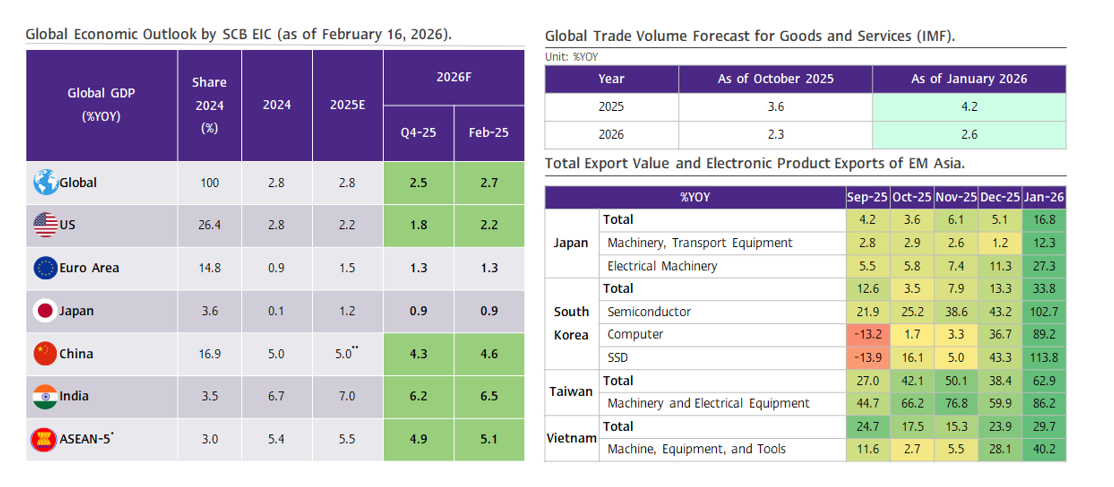
SCB EIC has revised Thai exports’ projection to return to expansion of 1.6% in 2026 (previously -1.5%). The upward revision reflects continued support from the electronics upcycle, driven by strengthening global demand, which has bolstered exports across several Asian economies, including Thailand as a key producer in this sector. This is illustrated in Figure 5 (bottom right), where export values of developing Asian economies continue to expand robustly, particularly in electronic products such as Taiwan, South Korea, Vietnam, and Thailand.
In addition, the outlook for the global economy and trade has improved. SCB EIC has revised up its global GDP growth forecast for 2026 to 2.7% (from 2.5%). Meanwhile, the International Monetary Fund (IMF) and the World Trade Organization (WTO) have also upgraded their projections for global trade volume in 2026, reflecting a more favorable global economic outlook. Rapid advancements in AI development are also expected to serve as a key driver of global trade this year and help mitigate the impact of US tariffs.

Figure 5: The Outlook for the Global Economy and Trade Has Improved.
trade-270226-05.png
Source: SCB EIC analysis based on data from the IMF and CEIC.


We use cookies and other similar technologies on our website to enhance your browsing experience. For more information, please visit our Cookies Notice.
Accept